ESTABLISHING SECURE CONNECTION...





RECON
SPACE
ALERTS
DRAW
OI · ASSIST & FORECAST
SEARCH & ROUTE
ARCGIS
CURSOR—
LOCATIONHOVER MAP
ZOOM2.5
Press ? for shortcuts · F fullscreen · R reset view

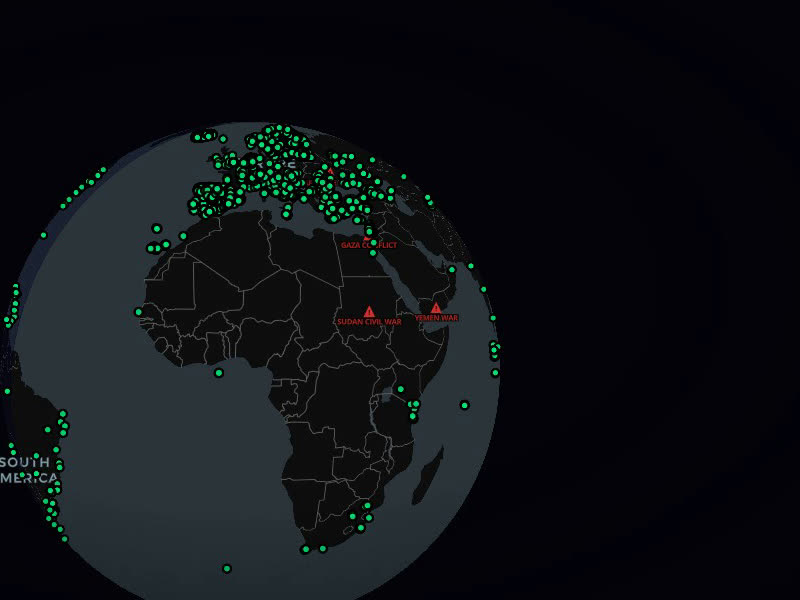
Watch live cams from cities, highways, mountains, beaches, and landmarks around the planet — every camera has a share link, so you can send someone straight to the exact view.
Public cameras on one globe
Countries with cameras on the globe
Largest camera network
Second-largest camera network
Quick answers
WorldEye is a free website that puts a live 3D globe of Earth in your browser — 74,229 public cameras, live flights, satellites, weather, earthquakes and wildfires on one map. There is nothing to install and no account needed to look around. Paid plans add an AI analyst, camera recording and alerts; Ultra adds the premium intelligence layers.
You can watch 74,229 live public cameras on WorldEye, plotted on one globe from 109 countries. The United States contributes the most — 41,355 cameras, largely state transportation-department networks — followed by Japan with 10,472. The mix covers highways, city streets, beaches, ski resorts, airports, harbors and nature reserves.
Yes — the globe, all the cameras, flight and satellite tracking, weather, earthquakes and basic search are free, and you never need an account to browse. The free plan includes 5 camera opens on the globe. Optional paid plans — Weekly at $7.99, Monthly at $13.99 and VIP Pro at $74.99 a year — remove that limit and add the AI analyst and camera recording; Ultra adds the premium intel layers.
Follow aircraft, satellites, maritime activity and live transit from one interactive platform.

Follow storms, wildfires, earthquakes, and environmental activity as data becomes available.
Powerful monitoring and research tools, together in one place.
Plans
$0 — no account needed
Weekly $7.99 · Monthly $13.99 · VIP Pro $74.99
Free trials: 3 days on weekly · 10 days on monthly & annual
Yes. The live globe — the map, 74,229 public cameras, flight and satellite tracking, live transit, weather radar, earthquakes, wildfires and basic search — is free to use with no account. WorldEye Pro is an optional subscription that adds the AI analyst, the live traffic layer and advanced search filters; Ultra adds the premium intelligence feeds.
No. Just open the site and you are looking at the planet. Accounts are free — subscribers use them for billing, affiliates for their links, and members get extra camera opens — never as a gate in front of the map.
Google Earth shows the recorded past; WorldEye shows right now. It fuses live streams — aircraft, satellites, weather, earthquakes, wildfires and 74,229 public cameras — onto one 3D globe that updates in real time.
Pro adds the OI AI analyst, the live traffic layer, advanced search filters and the camera recording studio. Ultra adds premium intel feeds such as cyber threats, maritime tracking and a live news feed, plus camera timelapse. Plans are weekly at $7.99, monthly at $13.99 and annual at $74.99. The weekly plan starts with a 3-day free trial, the monthly and annual plans start with a 10-day free trial, and you can cancel anytime in one click.
WorldEye aggregates publicly available camera feeds from around the world — traffic, city streets, landmarks and nature — into one browsable layer on the globe. They are third-party public sources, so individual feeds can go offline and coverage varies by region.
Yes. WorldEye runs in any modern browser — Chrome, Edge, Firefox and Safari — on desktop and mobile. There is nothing to install; just open worldeye.app.
Questions? Talk to a human — email us, use the contact page, or read about WorldEye.
WorldEye News
November 2, 2026
Cyclone Murasu strengthened into a severe cyclonic storm over the Bay of Bengal on Monday and is expected to cross the south Andhra Pradesh coast between Nellore and Narsapur, close to Ongole, between 11:30 p.m. IST on November 2 and 4 a.m. on November 3, with winds of 100–110 km/h gusting to 120 km/h, the India Meteorological Department said.
Read the story →November 2, 2026
The Taurids — the slow, bright 'Halloween fireballs' — reach their first November peak this week. The Southern Taurids top out on the night of November 4–5 under a waning crescent Moon only about 25% lit, with the Northern Taurids to follow on November 11–12, the American Meteor Society says.
Read the story →November 2, 2026
SpaceX's classified USSF-432 mission for the U.S. Space Force has slipped again: after listings for November 1 and then November 2, the Falcon 9 is now scheduled to lift off from Vandenberg's SLC-4E on Tuesday, November 3, in a four-hour window opening at 5:28 p.m. PT. It is the only California launch on the board this week.
Read the story →