 BLOG
When the Planes' Technology Stopped Working: Inside Friday's Nationwide Ground Stop
For more than four hours on Friday, November 13, the United States simply stopped flying. After communications problems struck the air traffic control network, the Federal Aviation Administration issued a nationwide ground stop — an order that every departing aircraft at every airport in the country remain on the ground until further notice. It was only the second nationwide ground stop since the September 11, 2001 attacks, and the longest since then.
The stop was cancelled at 8:15 p.m. Eastern time, but by then the damage was done: more than 9,100 flights cancelled and more than 24,500 delayed on Friday alone, according to FlightAware, with thousands more cancelled on Saturday as airlines dug out. Tens of thousands of passengers spent Friday night stranded in terminals, scrambling for rental cars, Amtrak trains and buses. No one was hurt — aircraft already in the air were never ordered down, and more than 3,500 of them landed safely — but the failure has reopened the argument over just how old the technology running American aviation really is.
▸ What time did the ground stop start and end?
The first sign of trouble came at 3:36 p.m. Eastern time, when, in Transportation Secretary Sean Duffy's words, the FAA started identifying “instability for our radar and our communications” at its traffic control centers. Controllers were receiving radar and communications intermittently — not a total blackout, but data the agency could no longer trust.
Just before 4 p.m. Eastern — the FAA Command Center logged the order at 20:54 UTC, or 3:54 p.m. Eastern — the agency issued the nationwide ground stop, citing “extraordinary circumstances” and safety concerns. Its public message was blunt: “There has been a temporary telecommunications outage — out of an abundance of caution all flights have been halted.” About 11,000 flights had been scheduled to depart U.S. airports after 4 p.m., according to aviation analytics firm Cirium, and every one of them was frozen. More than 3,500 airplanes were already airborne when the order came down; by 8 p.m., fewer than 400 remained in the sky. Exceptions were made for critical medevac, life-saving cargo and law enforcement flights.
The stop was lifted at 8:15 p.m. Eastern, with Duffy announcing “We've opened up the airspace” and confirming the system was operational; the FAA posted the cancellation on its website at about 8:30 p.m. From first instability to reopening, the failure consumed the entire Friday evening travel peak — roughly four hours and twenty minutes of stopped departures, the longest nationwide halt since 9/11.
▸ What technology actually stopped working?
The failure sat in the telecommunications network that links the FAA's 22 Air Route Traffic Control Centers — the en route centers that control high-altitude traffic between airports. The FAA said a communications issue impacted all of them at once, which is what turned a technology problem into a nationwide shutdown rather than a regional delay programme.
Duffy's explanation at the White House was unusually specific for a breaking failure. “What we have is an incredibly old air traffic control system,” he said, describing switches and routers in the system's analog technology that got “overloaded” with data. “They started to give us inconsistency in the data from those routers, and because of that we shut the system down.” The underlying technology, he noted, has been in place since the 1980s — and, pointedly, the small number of centers that have already been converted to digital IP systems did not break down.
Homeland Security Secretary Markwayne Mullin added a detail that sharpened the picture: the system failed while it was being worked on. The FAA “was putting (in) new equipment and new technology,” Mullin said, “and it was overwhelming the older system” — patches being applied to aging infrastructure at the moment it buckled.
▸ Was it a cyberattack — and did the new SMART system cause it?
Officials were emphatic on one point Friday night: there is no evidence of a cyberattack. Mullin said there was “zero evidence” of one — “no chatter, no footprints” — while adding that investigators had not ruled anything out entirely. No official root cause had been announced as of Saturday.
The most concrete unofficial account comes from CBS News, which reported, citing multiple sources, that an update to the private network connecting air traffic control facilities caused the network to reboot and then crash; the network is operated by contractor L3Harris, and SecurityWeek reported the FBI is probing the software update. That account fits the officials' description of new technology overwhelming old equipment, but it has not been confirmed by the FAA.
One obvious suspect has been publicly cleared by the administration: the FAA had rolled out SMART — the Strategic Management of Airspace, Routes and Trajectories — across the country only days earlier, and questions about the new system began within hours. Duffy said the disruption was not directly tied to SMART, and Air Space Intelligence, the contractor behind AI scheduling tools for the FAA, said its systems did not cause the interruption.
▸ How many flights were cancelled and delayed?
By FlightAware's count, Friday closed with more than 9,100 flights cancelled and more than 24,500 delayed on services within, into or out of the United States — making it the second-worst cancellation day of 2026, behind only the January 25 snowstorm's 11,607 cancellations. An estimated 1.5 million passengers were affected.
The bill kept growing after the airspace reopened, because aircraft and crews were in the wrong cities. By 8:17 a.m. Eastern on Saturday, airlines had already cancelled 3,568 of Saturday's flights, with Delta alone cancelling 640 — about 20 percent of its schedule. The disruption also crossed the Atlantic: Eurocontrol suspended U.S.-bound traffic from its member states at the FAA's request, and carriers in Ireland, Britain and mainland Europe were caught in the knock-on effects.
▸ What have officials said about fixing the system?
Friday's failure landed in the middle of a live political fight over modernising air traffic control. President Donald Trump has declared updating the system “a national emergency,” and Duffy used the White House briefing to renew the administration's request that Congress approve $30 billion for a full upgrade — funding Congress has not approved. “It's an old system that went down,” Duffy said.
Reuters' post-mortem put Friday in a pattern rather than treating it as a freak event: aging air traffic control equipment regularly disrupts U.S. flights. The last nationwide ground stop, in January 2023, was triggered by a different piece of legacy technology — the NOTAM pilot-alert system — failing overnight. Two nationwide shutdowns in under four years, both traced to old systems, is the statistic now driving the funding argument.
▸ When will flights be back to normal?
Not this morning. Duffy warned the disruption would ripple for days — “it's going to take us some time to unwind what's happened this afternoon” — and said he expects everything to be back to normal by Thanksgiving, with airlines resuming operations through the weekend. Delta and United said they were resuming flying, JetBlue planned to restart on Saturday morning, and Southwest resumed a limited operation while waiving rebooking fees.
If you are flying this weekend, the practical advice from the day is unglamorous: check your flight before leaving for the airport, expect hub airports — Chicago O'Hare, Dallas Fort Worth and Atlanta were among the hardest hit Saturday morning — to stay congested, and remember that a lifted ground stop does not put a single aircraft back where it was supposed to be.
▸ How the shutdown looked on the live flight tracker
Friday's strangest sight was the sky emptying in real time. Anyone watching a flight tracker watched more than 3,500 aircraft over the United States drain away to fewer than 400 by 8 p.m. — the arrivals finishing their journeys, and nothing taking off behind them — and then, after 8:15 p.m., the first departures blinking back into existence airport by airport.
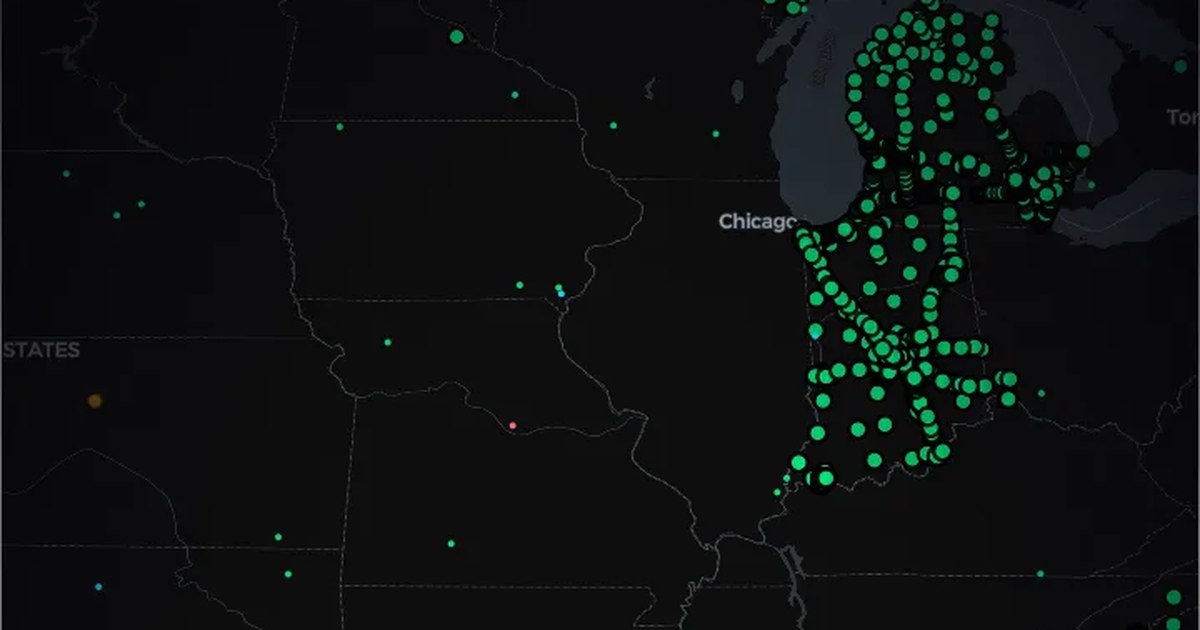
That recovery is still the story today. WorldEye's live flight tracker shows Saturday's repositioning in real time — which hubs are flowing again and where the gaps still are — on the same live globe as the site's 74,229 cameras, including airport webcams at fields that spent Friday evening going nowhere.
▸ Frequently asked questions
What caused the nationwide ground stop on November 13?+
A telecommunications outage hit the FAA's Air Route Traffic Control Centers. Transportation Secretary Sean Duffy said switches and routers in the system's analog technology — in place since the 1980s — became overloaded and fed controllers inconsistent radar and communications data, so the FAA shut departures down for safety. CBS News reported an update to the private network linking the centers caused a reboot and crash; the FAA has not announced an official root cause.
How long did the FAA ground stop last?+
The nationwide ground stop was issued just before 4 p.m. Eastern time on Friday, November 13 and lifted at 8:15 p.m. Eastern — more than four hours, the longest nationwide ground stop since the September 11, 2001 attacks.
How many flights were cancelled by the ground stop?+
More than 9,100 flights were cancelled and more than 24,500 delayed on Friday, according to FlightAware, and airlines had already cancelled more than 3,500 of Saturday's flights by Saturday morning as the backlog rolled into the weekend.
Was the FAA ground stop caused by a cyberattack?+
Officials say there is no evidence of one. Homeland Security Secretary Markwayne Mullin said there was “zero evidence” — no chatter and no footprints — though investigators had not ruled anything out entirely. The failure is blamed on aging telecommunications equipment being patched with new technology.
When will flights be back to normal after the ground stop?+
Secretary Duffy said recovery would take days and warned of disruption through the weekend, but he expects operations to be back to normal by Thanksgiving. Airlines resumed flying Friday night and Saturday morning, with aircraft and crew repositioning the main bottleneck.
▸ Sources
- USA Today: Thousands were stranded at America's airports. What went wrong?
- USA Today: FAA says it has lifted nationwide ground stop that snarled airports
- Reuters: Old air traffic control equipment regularly disrupts US flights
- FOX Weather: Thousands of flights canceled as US air travel recovers from historic ground stop
See it live on WorldEye
This post is a snapshot — the planet keeps moving. The cameras, flights and events WorldEye tracks are streaming on the live globe right now.
Enjoying the free globe? Help keep it free.
WorldEye is independent and ad-free. Chip in to help cover the servers and data feeds.
One email when the sky does something big
Rocket launches, storms overhead and new camera drops — plus major WorldEye news. Rare, and no spam, ever.
Instant subscribe — no confirmation email. We check the address as you type it in.