SATELLITE IMAGERY HEAD-TO-HEAD
God's Eye View vs NASA Worldview (2026)
God's Eye View and NASA Worldview both promise the real planet, free — from opposite altitudes. God's Eye View is open-source software (by Bilawal Sidhu and Sameh Khamis) that you install on your own computer: a photorealistic 3D globe alive with flights, ships, satellites and cameras, driven by voice. NASA Worldview is NASA's hosted instrument: over a thousand scientific satellite layers refreshed within hours, built for watching fires, storms, ice and oceans change. One puts you inside the moving world; the other looks down on its systems.
God's Eye View is the view from inside the scene — live movement on a photoreal 3D globe you own. NASA Worldview is the view from orbit — the deepest free record of the planet's changing systems. The first is software you install; the second is an instrument you simply open.
Last reviewed: October 2026 · Sources listed at the bottom of this page
Quick facts
| God's Eye View | NASA Worldview | |
|---|---|---|
| Model | Free open-source software — install and run it yourself | Hosted NASA application — open it in a browser |
| Maker | Bilawal Sidhu and Sameh Khamis (Halfpixel) | NASA EOSDIS |
| Runs on | Your own computer — Windows, macOS, Linux | Any modern browser, nothing to install |
| Free tier | Everything — the software itself is free | Everything — a NASA public service |
| Paid tier | None — optional third-party API keys meter separately | None — no paid plans |
| Camera claim | ~4,000 public cameras in its CCTV Mesh layer | No live cameras — satellite imagery only |
Key differences at a glance
- Open it with no installGod's Eye View: NoNASA Worldview: YesGod's Eye View installs locally (Pinokio, terminal or Docker); NASA Worldview runs in the browser with no signup
- Photorealistic 3D globeGod's Eye View: YesNASA Worldview: NoGod's Eye View renders Google Photorealistic 3D Tiles; Worldview is a flat map with polar projections
- Near-real-time satellite imageryGod's Eye View: PartialNASA Worldview: YesMost Worldview layers update within ~3 hours of observation across 1,000+ full-resolution layers; God's Eye View carries satellite clouds and a satellite basemap, not a science imagery library
- Live public camerasGod's Eye View: PartialNASA Worldview: NoGod's Eye View projects ~4,000 CCTV cameras into the 3D scene (its stated shared cap); Worldview has no camera network
What is God's Eye View?
God's Eye View is an open-source 3D world globe simulator — 'a spy-satellite simulator in your browser, except the data is real.' It renders Google Photorealistic 3D Tiles through Cesium and layers live aircraft, ships, satellites, earthquakes, traffic and public cameras from open sources, all processed locally in your browser. It went viral in 2026 for its voice-controlled AI agent, cockpit view and sensor-style visual modes. It is software you run yourself — via Pinokio one-click, a terminal install, or Docker — not a website you open.
What is NASA Worldview?
NASA Worldview is NASA EOSDIS's free, open-source browser for near-real-time satellite imagery: more than 1,000 global, full-resolution layers — fires, storms, air quality, sea ice, vegetation and more — most updated within about three hours of observation, some spanning nearly 30 years. It adds event pins for cyclones, wildfires and eruptions, time-lapse animation building, layer comparison (swipe and opacity) and downloadable underlying data via NASA's GIBS services. No signup; it runs in the browser.
God's Eye View vs NASA Worldview: feature comparison
Verified against official sources. “Not verified” means we couldn’t confirm it — not that it doesn’t exist.
FEATURE TALLY — FROM THE TABLE BELOW
God's Eye View
7 yes · 5 partial · 1 no · 1 not verified
NASA Worldview
8 yes · 0 partial · 4 no · 2 not verified
A count of the rows in the verified table beneath — not a quality rating. The rows themselves, and what each product does best, matter more than the totals.
| Feature | God's Eye View | NASA Worldview |
|---|---|---|
| Open it with no installGod's Eye View installs locally (Pinokio, terminal or Docker); NASA Worldview runs in the browser with no signup | No | Yes |
| Photorealistic 3D globeGod's Eye View renders Google Photorealistic 3D Tiles; Worldview is a flat map with polar projections | Yes | No |
| Near-real-time satellite imageryMost Worldview layers update within ~3 hours of observation across 1,000+ full-resolution layers; God's Eye View carries satellite clouds and a satellite basemap, not a science imagery library | Partial | Yes |
| Live public camerasGod's Eye View projects ~4,000 CCTV cameras into the 3D scene (its stated shared cap); Worldview has no camera network | Partial | No |
| Live flights (ADS-B)God's Eye View tracks live aircraft including a separate military layer; Worldview is satellite imagery only | Yes | No |
| Live ships (AIS)God's Eye View's vessel layer needs a free AISStream key; Worldview has ocean layers but no vessel tracking | Partial | No |
| Live satellite positions and ISS trackingGod's Eye View tracks satellites from CelesTrak with pass predictions; live position tracking is not confirmed on Worldview's official pages checked — it displays imagery from satellites | Yes | Not verified |
| Weather and environmental layersGod's Eye View: keyless wind, radar, clouds, lightning and cyclone tracks. Worldview: air quality, temperature, precipitation and storm layers — environmental, not forecast | Yes | Yes |
| Natural-event tracking (fires, storms, eruptions)Worldview pins and tracks active cyclones, wildfires and eruptions; God's Eye View has fire layers (NASA FIRMS, free key) and cyclone tracks but no event-tracking desk | Partial | Yes |
| Science data layers and downloadsWorldview offers 1,000+ layers and downloadable NASA data via GIBS; a downloadable science-data library is not confirmed on God's Eye View's official pages checked | Not verified | Yes |
| Time archive and time-lapseWorldview builds custom time-lapse animations and some layers span nearly 30 years; God's Eye View's time controls are specific — a weather timeline and scrubbable launch replays, not a general archive | Partial | Yes |
| AI assistantGod's Eye View: a hands-free voice agent that drives the globe, on your own OpenAI key. An equivalent agent is not confirmed on Worldview's official pages checked | Yes | Not verified |
| Open sourceBoth are open source — God's Eye View under the MIT licence, Worldview as NASA's open-source EOSDIS application | Yes | Yes |
| Completely free, no paid tierGod's Eye View is free software (optional third-party keys meter separately); Worldview is a NASA public service with no paid plans and no signup to browse | Yes | Yes |
Pricing: God's Eye View vs NASA Worldview
God's Eye View pricing
There is no God's Eye View price or subscription — the software is free and open source. The README's own cost table is honest about the edges: most layers cost $0 with no signup; a free-key tier (AISStream, NASA FIRMS, Cesium ion within quota) unlocks more; the voice agent spends your own OpenAI credit with a $2 warning and $5 hard cap per session; and photoreal tiles through a direct Google key are metered by Google.
NASA Worldview pricing
Completely free — NASA provides Worldview as a public service through EOSDIS. No paid plans, and no signup is required to browse.
God's Eye View: pros and cons
- Completely free and open source (MIT) — no subscription, ever
- Live flights, ships, satellites, earthquakes and cameras on one 3D globe
- Voice-controlled AI agent — talk to the globe
- Runs locally: your data and keys stay on your machine
- Endlessly extendable — every layer is a module
- You must install and run it yourself (Pinokio, terminal or Docker)
- Camera layer is small (~4,000) beside hosted atlases
- Ships need a free third-party key; voice spends your OpenAI credit
- No science-layer library or downloadable research data
- No general history archive — only specific timelines such as weather and launches
NASA Worldview: pros and cons
- 1,000+ full-resolution satellite layers, most hours old
- Geostationary imagery in 10-minute increments
- Event pins for cyclones, wildfires and eruptions
- Time-lapse animations, layer comparison and downloadable data
- Completely free from NASA — no signup, open source
- No live cameras, aircraft or vessel tracking at all
- A working research console — not a casual, cinematic explorer
- No photorealistic 3D globe or street-level view
- Event pins highlight active events, but there are no push alerts
The verdict
Choose God's Eye View if…
Choose God's Eye View if you want the planet in motion at ground level — live flights, ships, cameras and satellites on a photoreal 3D globe you control by voice — and you're comfortable installing software to get it free and open forever.
Choose NASA Worldview if…
Choose NASA Worldview if you watch systems — tracking a wildfire's spread, a hurricane's approach, sea-ice retreat or air-quality plumes with imagery that is hours old, across 1,000+ layers, free from NASA.
Is God's Eye View better than NASA Worldview?
They answer different questions. God's Eye View is a free, open-source 3D globe you run on your own computer — built for live movement: aircraft, ships, satellites and cameras in a photoreal scene you can talk to. NASA Worldview is NASA's hosted instrument — built for processes: 1,000+ scientific satellite layers, hours old, with time-lapse and downloadable data. If you want to watch the planet move, install God's Eye View; if you want to study how its systems are changing, open NASA Worldview.
ANOTHER OPTION
Where WorldEye fits
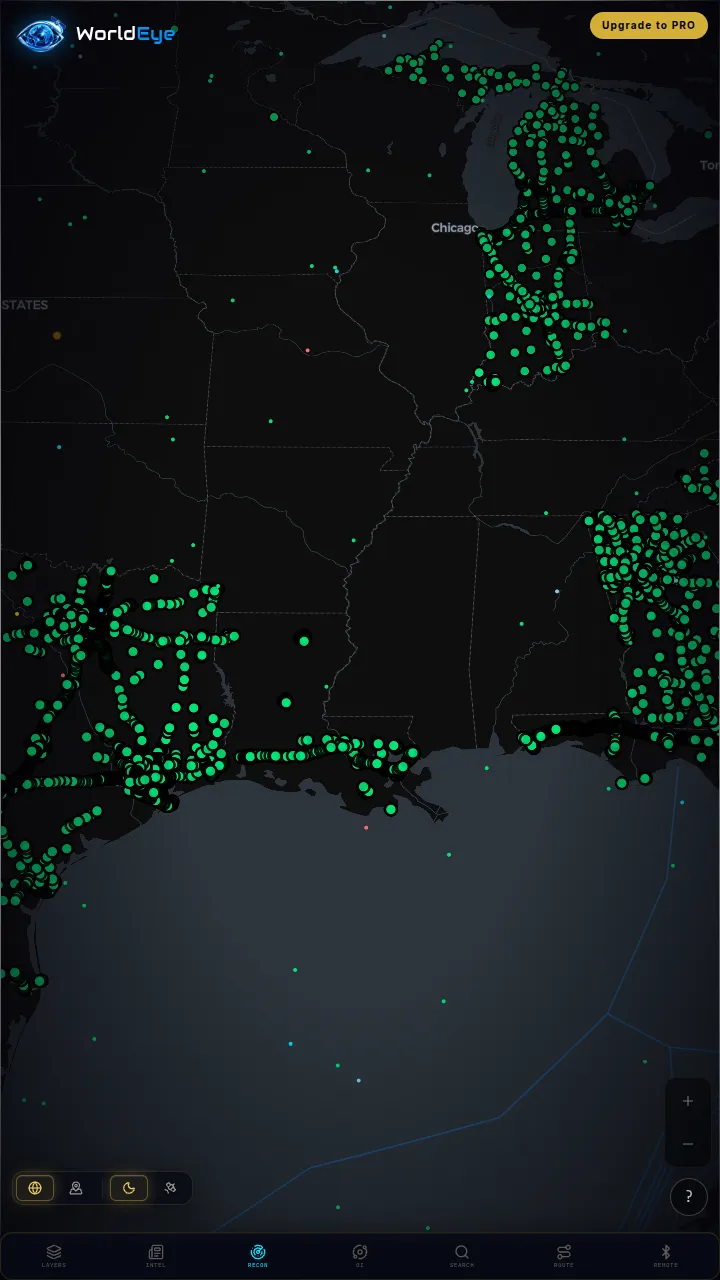
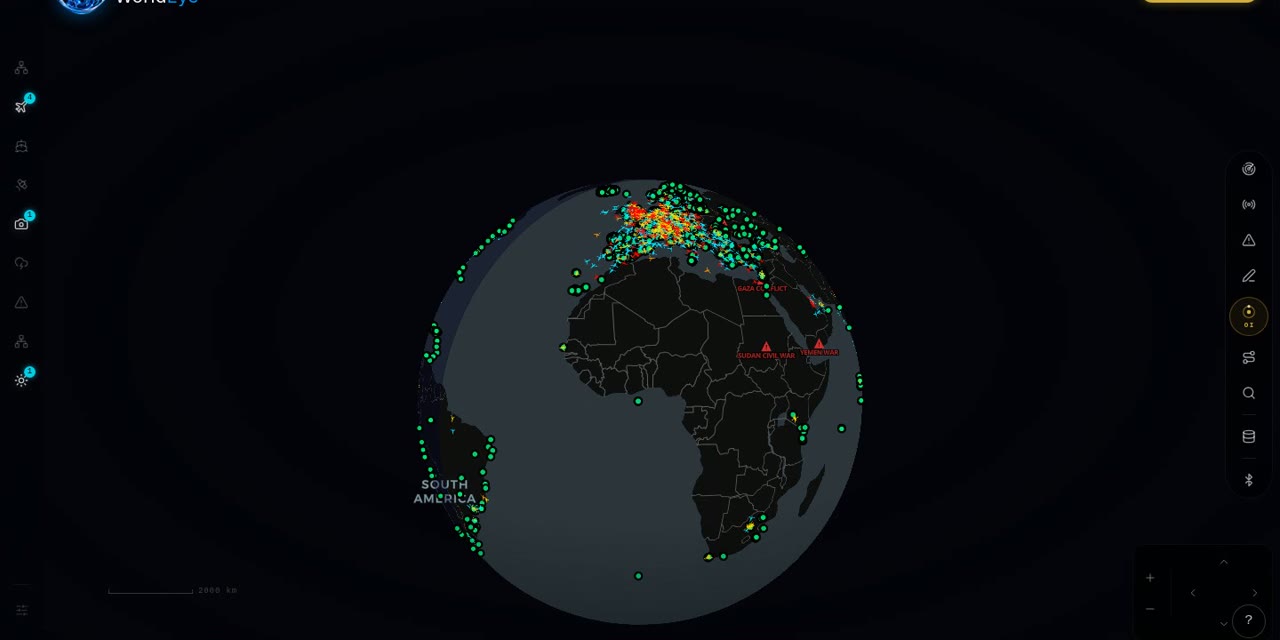
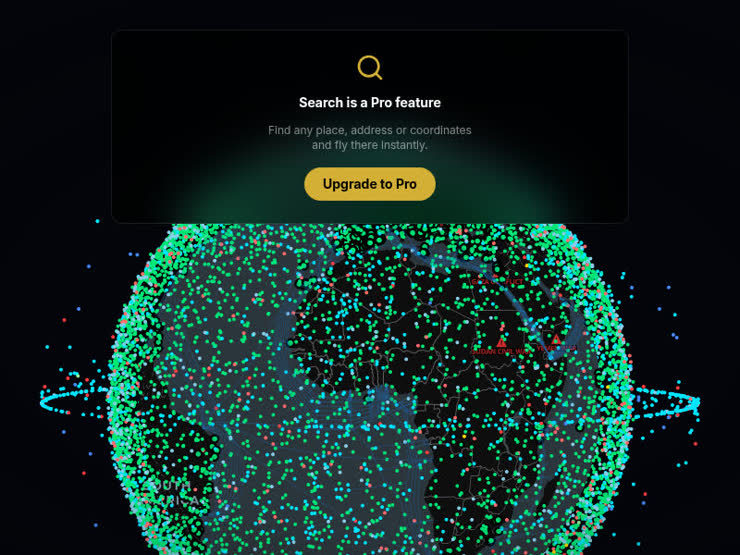
If installing software is the dealbreaker in God's Eye View, and NASA Worldview's science console has no cameras or live movement, WorldEye is the middle path: a hosted 3D globe that opens free in any browser with no signup at all — 74,229 public cameras across 105 countries, live flights, ships, satellites, weather, earthquakes and wildfires in the same view. Its imagery is neither NASA's 1,000-layer science library nor God's Eye View's photoreal 3D tiles, and it doesn't claim to be; its Pro tier ($7.99/week, $13.99/month or $74.99/year) buys an OSINT toolkit and intel feeds rather than research data.
Live on WorldEye right now
Real cameras from WorldEye's live catalogue — no account, no install. Tap any frame to open that exact camera on the globe.
Full WorldEye head-to-heads: WorldEye: the God's Eye View alternative · WorldEye vs NASA Worldview
God's Eye View vs NASA Worldview: quick answers
Is God's Eye View the same as NASA Worldview?
No — they are unrelated products. God's Eye View is free open-source software by Bilawal Sidhu and Sameh Khamis that you install and run locally. NASA Worldview is NASA EOSDIS's hosted browser for satellite imagery. They share open data and little else.
Is God's Eye View really free?
Yes. The software is free and open source under the MIT licence. The only costs are optional third-party ones you control: the voice agent uses your own OpenAI API credit (the app warns at $2 and caps at $5 per session), and photoreal 3D tiles can be metered if you use a direct Google key instead of the free Cesium ion route.
How many layers does NASA Worldview have?
More than 1,000 global layers — satellite imagery and science products covering fires, storms, air quality, temperature, sea ice, vegetation and hundreds of other variables, many updated near-real-time.
Which has live cameras, God's Eye View or NASA Worldview?
Only God's Eye View: its CCTV Mesh layer states a shared cap of about 4,000 cameras, projected into its 3D scene. NASA Worldview has no camera network — it shows the planet from orbit. For comparison, WorldEye's directory lists 74,229 public cameras.
Do I need to install anything for NASA Worldview?
No. NASA Worldview runs in the browser with no signup. God's Eye View is the opposite: no account at all, but you install it on your own computer first.
Which is closer to live?
NASA Worldview: most of its layers update within about three hours of satellite observation, with geostationary imagery in 10-minute increments. God's Eye View's live feeds refresh far faster — its own notes put most feeds at every 15–30 seconds — but they are movement data (flights, ships, cameras), not full-resolution science imagery.
How we researched this comparison
Every row in the table above was checked against God's Eye View’s and NASA Worldview’s official sites, documentation or published pricing — the sources are listed at the bottom of this page, and the comparison was last reviewed in October 2026. Where a capability couldn’t be confirmed from an official source, it is marked “Not verified” rather than guessed.
This page is published by WorldEye, so the head-to-head above is kept deliberately neutral: each product’s strengths are stated in its own terms, and WorldEye appears only in the labelled “another option” section. WorldEye’s own figures there are counted, not estimated — 74,229 public cameras in its live directory across 105 countries, and a free map (flights, satellites, ships, weather, earthquakes, wildfires, cameras and satellite imagery) with an optional Pro tier at $7.99/week, $13.99/month or $74.99/year.
Products change. If you spot a row that has gone stale, the sources below show exactly what each claim rests on.