SHIP TRACKING HEAD-TO-HEAD
MarineTraffic vs ShipFinder (2026)
MarineTraffic and ShipFinder both answer the same question — where is that ship, and where is it going? MarineTraffic is the industry's default: thousands of shore AIS receivers, live ETAs and arrival/departure schedules for 4,000+ ports, deep history and a compliance business built on top. ShipFinder, at shipfinder.com, is a newer web platform built around satellite + terrestrial AIS, leading with a free satellite-tracked vessel and simple $29 and $99 plans. If you track ships for work or for love, this is a choice between port-and-history depth and satellite-first simplicity.
MarineTraffic is the depth play — ports, schedules, playback and history built over nearly two decades. ShipFinder is the satellite play — satellite AIS from the free tier up, at two simple published prices. The first sells institutional data; the second sells open-ocean positions.
Last reviewed: October 2026 · Sources listed at the bottom of this page
Quick facts
| MarineTraffic | ShipFinder | |
|---|---|---|
| Model | Hosted website and apps — free tier with registration | Hosted website only — freemium subscription |
| Maker | MarineTraffic (founded 2007) | ShipFinder at shipfinder.com, associated with Elane |
| Runs on | Web, plus iOS and Android apps | Any modern browser, including mobile browsers — no app download |
| Free tier | Live map, with menus and features behind registration | $0 plan: satellite AIS for 1 vessel, 3-day history, fleet of 10 |
| Paid tier | Basic £10/user/month up to custom-priced Enterprise | Standard $29/month or $290/year; Professional $99/month or $990/year; Enterprise contact-only |
| History | 7-day track history on Essential; up to 5 years on Enterprise | 3 days free, 7–14 days on Standard per its own pages, 6 months on Professional, 10+ years on Enterprise |
Key differences at a glance
- Port schedules and live ETAsMarineTraffic: YesShipFinder: PartialMarineTraffic covers 4,000+ ports with arrival/departure schedules; ShipFinder offers route prediction and ETA for vessels plus port search and port calls, without the same published schedule depth
- Density heatmapsMarineTraffic: Not verifiedShipFinder: YesShipFinder lists density heatmaps at every plan level; a comparable MarineTraffic feature was not confirmed in the sources checked
- Data exportsMarineTraffic: Not verifiedShipFinder: YesShipFinder lists unlimited data exports at every plan level; MarineTraffic export terms were not confirmed in the sources checked
- Weather overlays and forecastsMarineTraffic: YesShipFinder: Not verifiedMarineTraffic includes 48-hour wind forecasts and weather layers; no weather layer was stated on the ShipFinder pages checked
What is MarineTraffic?
MarineTraffic (founded 2007) is the default ship-tracking platform: real-time vessel positions from thousands of shore AIS receivers, live ETAs and arrival/departure schedules for 4,000+ ports, vessel particulars and photos, port-call logs and animated voyage playback. The free tier opens the map but reserves menus and features for registered users; paid plans scale from a 10-vessel Basic list up to Enterprise fleets of 2,000 vessels with five years of history. Its parent company also sells risk, compliance and port-intelligence products built on the same data.
What is ShipFinder?
ShipFinder at shipfinder.com is a web-only satellite + terrestrial AIS platform associated with Elane. It combines land-based AIS with satellite AIS for open-ocean coverage, and pairs live positions with historical tracks and playback, port calls, route prediction and ETAs, fleet management and vessel event alerts, plus an AIS API and an Enterprise tier. There is no app to download — its Help Center says to use it in a mobile browser, with the account and data syncing to the desktop version. Its own pages publish no vessel or port count.
MarineTraffic vs ShipFinder: feature comparison
Verified against official sources. “Not verified” means we couldn’t confirm it — not that it doesn’t exist.
FEATURE TALLY — FROM THE TABLE BELOW
MarineTraffic
10 yes · 2 partial · 0 no · 3 not verified
ShipFinder
10 yes · 3 partial · 1 no · 1 not verified
A count of the rows in the verified table beneath — not a quality rating. The rows themselves, and what each product does best, matter more than the totals.
| Feature | MarineTraffic | ShipFinder |
|---|---|---|
| Live AIS ship mapThe core of both products | Yes | Yes |
| Satellite AIS (open-ocean positions)MarineTraffic: from Essential, one vessel at a time. ShipFinder: 1 vessel free, 5 on Standard, unlimited on Professional | Yes | Yes |
| Port schedules and live ETAsMarineTraffic covers 4,000+ ports with arrival/departure schedules; ShipFinder offers route prediction and ETA for vessels plus port search and port calls, without the same published schedule depth | Yes | Partial |
| Historical track history and playbackMarineTraffic playback reaches 5 years on Enterprise; ShipFinder runs 3 days free, 7–14 days on Standard per its own pages, 6 months on Professional and 10+ years on Enterprise | Yes | Yes |
| Fleet listsMarineTraffic: 10 vessels (Basic) to 2,000 (Enterprise). ShipFinder: 10 (Free), 20 (Standard), 100 (Professional) | Yes | Yes |
| Vessel photos and particularsBoth pair positions with photos and vessel data such as type, IMO, MMSI, dimensions and tonnage | Yes | Yes |
| Notifications and alertsMarineTraffic includes notifications on paid plans (100/month on Basic); ShipFinder lists vessel alerts at every plan level, including arrivals, departures, zone entry/exit and speed changes | Yes | Yes |
| Route prediction and ETAMarineTraffic pairs live port ETAs with a voyage planner; ShipFinder lists route prediction and ETA at every plan level | Yes | Yes |
| Density heatmapsShipFinder lists density heatmaps at every plan level; a comparable MarineTraffic feature was not confirmed in the sources checked | Not verified | Yes |
| Data exportsShipFinder lists unlimited data exports at every plan level; MarineTraffic export terms were not confirmed in the sources checked | Not verified | Yes |
| API and data feedsMarineTraffic offers a commercial API on paid plans; ShipFinder offers an AIS API with a Starter API Key giving free trial access to selected APIs for a limited period | Partial | Partial |
| Weather overlays and forecastsMarineTraffic includes 48-hour wind forecasts and weather layers; no weather layer was stated on the ShipFinder pages checked | Yes | Not verified |
| Nautical chartsShipFinder lists nautical charts at every plan level; a comparable MarineTraffic chart feature was not confirmed in the sources checked | Not verified | Yes |
| Free tier without payingMarineTraffic's free tier requires registration for features; ShipFinder's free $0 plan asks you to create a free account and includes satellite AIS for 1 vessel | Partial | Partial |
| Native mobile appsMarineTraffic has iOS and Android apps; ShipFinder's Help Center says to use it in a mobile browser — no app download is needed | Yes | No |
Pricing: MarineTraffic vs ShipFinder
MarineTraffic pricing
Free tier with registration required for features. Web plans are licensed per user: Basic £10/user/month (10 vessels, 100 notifications/month), Essential £100/user/month (adds 7-day track history and satellite positions for one vessel at a time), and Enterprise on request (2,000 vessels, 5-year history, unlimited notifications). A cheaper Mobile Pro plan is sold inside its apps.
ShipFinder pricing
Free $0 (satellite AIS for 1 vessel, 3-day history, fleet of 10). Standard $29/month or $290/year (5 satellite vessels, fleet of 20; history is listed as 14 days on its pricing page and 7 days in its Help Center). Professional $99/month or $990/year (unlimited satellite AIS, 6-month history, fleet of 100). Enterprise is contact-only, with 10+ years of historical vessel data. Unlimited data exports, nautical charts, route prediction and ETA, density heatmaps and vessel alerts are listed at every level.
MarineTraffic: pros and cons
- 4,000+ port schedules with live ETAs and port-call logs
- Deep history — animated playback up to 5 years on Enterprise
- 48-hour wind forecasts, voyage planner and fleet management
- Native iOS and Android apps as well as the web map
- Mature commercial API for professional data work
- Free tier requires registration before menus and features open
- Satellite positions start on Essential, and then only one vessel at a time
- Essential is £100/user/month — a steep step up from Basic
- Priced per user, so team costs scale with every seat
ShipFinder: pros and cons
- Satellite AIS even on the free $0 plan (1 vessel)
- Unlimited satellite AIS on Professional at a flat $99/month
- Exports, nautical charts, route prediction, heatmaps and alerts at every level
- Simple published pricing — $29 or $99 a month, no per-user licence
- Nothing to install: desktop and mobile in the browser
- Web only — no native iOS or Android app to download
- Its own pages conflict on Standard history (14 days vs 7 days)
- No vessel or port count is published on its official pages
- Fleet lists top out at 100 vessels on Professional
- Enterprise pricing is contact-only, not published
The verdict
Choose MarineTraffic if…
Choose MarineTraffic if ships are your job — port operations, fleet management, journalism or compliance — and you need schedules, ETAs, playback and years of history more than you need a low price.
Choose ShipFinder if…
Choose ShipFinder if satellite coverage is the point — you want a free satellite-tracked vessel to start, unlimited satellite AIS at a flat $99/month, and a browser-only tool with no app to install.
Is MarineTraffic better than ShipFinder?
MarineTraffic is better for professional depth — port schedules, ETAs, playback, history and compliance-grade data. ShipFinder is better for satellite value — satellite positions from the free tier up, and unlimited satellite AIS at $99/month without per-user pricing. Casual viewers checking one ship are served by either free tier; the paid decision is really about whether you need MarineTraffic's port and history machinery or ShipFinder's open-ocean coverage.
ANOTHER OPTION
Where WorldEye fits
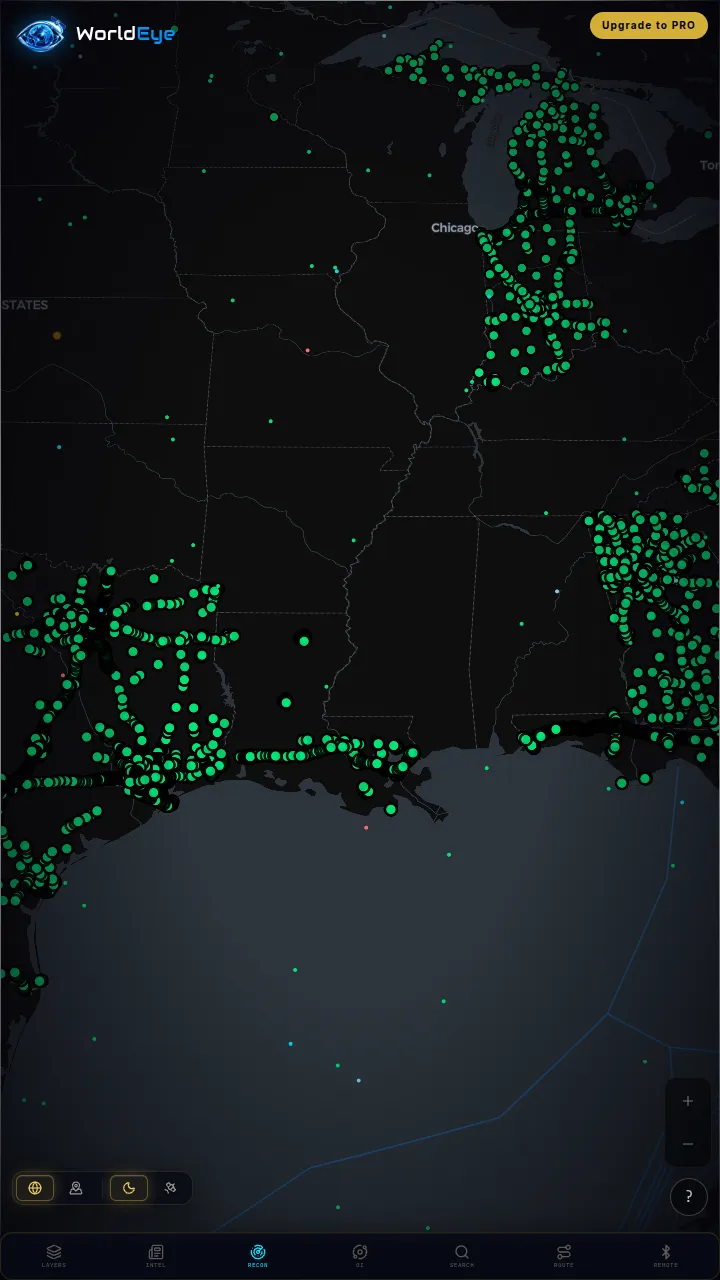
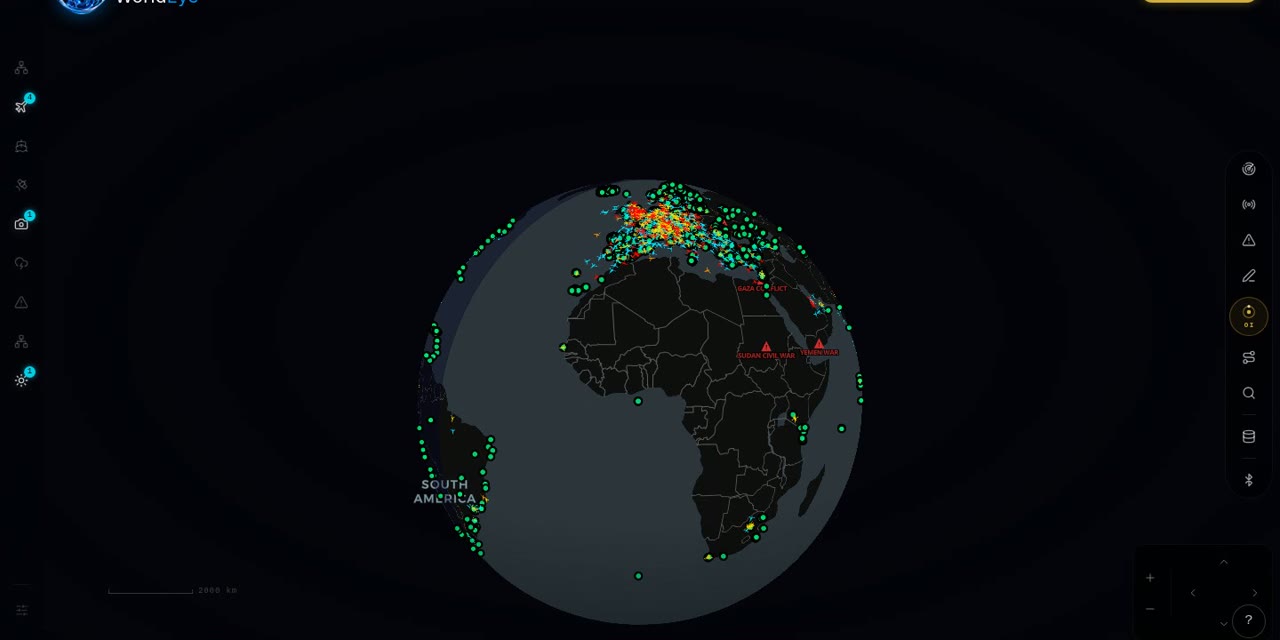
For casual watching, WorldEye shows live ships free on a 3D globe — no registration at all — in the same view as live flights, satellites, weather, earthquakes, wildfires and 74,229 public cameras across 105 countries. It has neither MarineTraffic's port machinery nor ShipFinder's satellite-AIS plans or fleet-management features; it's the free, everything-at-once picture. An optional Pro tier ($7.99/week, $13.99/month or $74.99/year) adds the OSINT toolkit and intel feeds.
Live on WorldEye right now
Real cameras from WorldEye's live catalogue — no account, no install. Tap any frame to open that exact camera on the globe.
Full WorldEye head-to-heads: WorldEye vs MarineTraffic
MarineTraffic vs ShipFinder: quick answers
Are there two different products called Ship Finder?
Yes — they are unrelated. This page is about ShipFinder at shipfinder.com, a web-based satellite + terrestrial AIS platform associated with Elane, with Free, Standard ($29/month) and Professional ($99/month) plans and no app to download. The other one is Pinkfroot's Ship Finder app at shipfinder.co — a separate consumer app sold in the Apple App Store. Prices and claims from the Pinkfroot app do not belong to shipfinder.com, and vice versa.
How much does MarineTraffic cost?
MarineTraffic's Basic plan is £10 per user per month (10 vessels, 100 notifications/month); Essential is £100 per user per month and adds 7-day history plus satellite positions for one vessel at a time; Enterprise is quoted and reaches 2,000 vessels with 5-year history. A free tier exists, but registration is required for features.
How much does ShipFinder cost?
ShipFinder at shipfinder.com is free at $0 (satellite AIS for 1 vessel, 3-day history, fleet of 10). Standard is $29/month or $290/year (5 satellite vessels, fleet of 20) and Professional is $99/month or $990/year (unlimited satellite AIS, 6-month history, fleet of 100). Enterprise is contact-only.
Which has better satellite coverage, MarineTraffic or ShipFinder?
Both combine terrestrial and satellite AIS, but they package it differently. MarineTraffic includes satellite positions from its Essential plan, for one vessel at a time. ShipFinder includes satellite AIS at every level — 1 vessel free, 5 on Standard and unlimited on Professional — so for tracking many vessels offshore at a published price, ShipFinder is the simpler buy.
How much history does ShipFinder really offer?
Free covers 3 days and Professional covers 6 months consistently across its pages. Standard is where its own pages conflict: the pricing page says 14 days of history, while its Help Center says 7 days — so treat Standard history as 7–14 days. Enterprise is listed with 10+ years of historical vessel data.
Is there a free ship tracker with no registration?
WorldEye shows live ship positions free on its 3D globe — no registration — together with flights, satellites, weather and 74,229 cameras. For port schedules, playback and history, MarineTraffic and ShipFinder remain the specialists.
How we researched this comparison
Every row in the table above was checked against MarineTraffic’s and ShipFinder’s official sites, documentation or published pricing — the sources are listed at the bottom of this page, and the comparison was last reviewed in October 2026. Where a capability couldn’t be confirmed from an official source, it is marked “Not verified” rather than guessed.
This page is published by WorldEye, so the head-to-head above is kept deliberately neutral: each product’s strengths are stated in its own terms, and WorldEye appears only in the labelled “another option” section. WorldEye’s own figures there are counted, not estimated — 74,229 public cameras in its live directory across 105 countries, and a free map (flights, satellites, ships, weather, earthquakes, wildfires, cameras and satellite imagery) with an optional Pro tier at $7.99/week, $13.99/month or $74.99/year.
Products change. If you spot a row that has gone stale, the sources below show exactly what each claim rests on.