LIVE INTEL MAPS HEAD-TO-HEAD
World Monitor vs LiveUAMap (2026)
World Monitor and LiveUAMap both put world events on a live map, but they trust different things. World Monitor is free, open-source software by Elie Habib that fuses hundreds of news and OSINT feeds with conflicts, fires, earthquakes, aircraft, ships and markets across 59 layer types — breadth and correlation, with no signup. LiveUAMap is the veteran: founded in 2014, it plots news across more than 30 regions only after AI crawlers surface stories and human analysts fact-check them — depth and verification, region by region.
World Monitor is the breadth play — a free, open-source dashboard that fuses everything it can ingest. LiveUAMap is the trust play — a slower, narrower news map where people verify stories before they are plotted. Neither shows you live cameras; both show you live events, by opposite methods.
Last reviewed: October 2026 · Sources listed at the bottom of this page
Quick facts
| World Monitor | LiveUAMap | |
|---|---|---|
| Model | Free open-source dashboard — hosted or self-hosted | Hosted news site — free with ads, paid premium plans |
| Maker / founded | Elie Habib | Founded 2014, during the Ukrainian conflict |
| Runs on | Web, Windows/macOS/Linux desktop apps, Android TV | Web, iOS and Android apps |
| Free tier | Full dashboard, no signup — all layers except Resilience | Web map with ads; no joint regions or previous-years history |
| Paid tier | Pro $39.99/mo; Pro Business $49.99/mo; API $99.99–$299.99/mo | Ad-free $9.54/half-year; PRO from $7/mo |
| Signature strength | 59 layer types and 468 feeds (site's own dated homepage figures) | 30+ regions of analyst fact-checked, archived news |
Key differences at a glance
- Open sourceWorld Monitor: YesLiveUAMap: NoWorld Monitor is AGPL-3.0 with self-hosting guides; LiveUAMap is a closed hosted service
- Analyst fact-checked newsWorld Monitor: PartialLiveUAMap: YesLiveUAMap routes crawler-found stories to expert analysts for fact-checking before publication; World Monitor fuses feeds and AI-synthesised briefs rather than running an analyst desk
- Curated regional news mapsWorld Monitor: PartialLiveUAMap: YesLiveUAMap covers 30+ dedicated regions and topics; World Monitor is one global map with country briefs on click, plus topic variants rather than editorial regions
- Chronological archive and historyWorld Monitor: Not verifiedLiveUAMap: YesLiveUAMap keeps a complete chronological archive — earlier years are a premium feature; a comparable archive is not documented on World Monitor's official pages
What is World Monitor?
World Monitor is a free, open-source (AGPL-3.0) intelligence dashboard by Elie Habib, hosted at worldmonitor.app and also self-hostable from its public source. Its homepage, dated 26 October 2026, cites 468 news and OSINT feeds and 59 map layer types spanning geopolitics, conflicts, military movements, fires, earthquakes, aircraft, ships, markets and infrastructure, correlated so converging events surface together. The same codebase powers six variants — geopolitics, tech, finance, commodity, energy and positive news — plus native desktop apps, a REST API and an MCP server. No webcam feature appears on its official pages.
What is LiveUAMap?
LiveUAMap — the Live Universal Awareness Map — is an independent news and information site founded in 2014 to cover the Ukrainian conflict, expanding by viewer request to more than 30 regions and topics including Syria and Israel-Palestine. Its map-centric model uses proprietary AI web crawlers to find newsworthy stories, which are forwarded to a group of expert analysts for fact-checking before editors decide what appears on the map. It keeps a complete chronological archive for researching past events, runs on the web and in iOS and Android apps, and is funded mainly by advertising.
World Monitor vs LiveUAMap: feature comparison
Verified against official sources. “Not verified” means we couldn’t confirm it — not that it doesn’t exist.
FEATURE TALLY — FROM THE TABLE BELOW
World Monitor
10 yes · 2 partial · 1 no · 2 not verified
LiveUAMap
6 yes · 2 partial · 6 no · 1 not verified
A count of the rows in the verified table beneath — not a quality rating. The rows themselves, and what each product does best, matter more than the totals.
| Feature | World Monitor | LiveUAMap |
|---|---|---|
| Free access with no signupWorld Monitor: the dashboard is free with no signup, every layer except Resilience included. LiveUAMap: the web maps are publicly accessible with advertising | Yes | Yes |
| Open sourceWorld Monitor is AGPL-3.0 with self-hosting guides; LiveUAMap is a closed hosted service | Yes | No |
| Analyst fact-checked newsLiveUAMap routes crawler-found stories to expert analysts for fact-checking before publication; World Monitor fuses feeds and AI-synthesised briefs rather than running an analyst desk | Partial | Yes |
| Live conflict events mapWorld Monitor draws on ACLED and UCDP conflict data with instability scoring; LiveUAMap maps curated conflict reporting region by region | Yes | Yes |
| Curated regional news mapsLiveUAMap covers 30+ dedicated regions and topics; World Monitor is one global map with country briefs on click, plus topic variants rather than editorial regions | Partial | Yes |
| Chronological archive and historyLiveUAMap keeps a complete chronological archive — earlier years are a premium feature; a comparable archive is not documented on World Monitor's official pages | Not verified | Yes |
| Live aircraft trackingWorld Monitor tracks military and civilian aircraft (OpenSky Network per its landing page); LiveUAMap has no flight layer | Yes | No |
| Live ships (AIS)World Monitor shows AIS vessel positions and 13 maritime chokepoints with live vessel counts; LiveUAMap has no ship layer | Yes | No |
| Live public camerasNeither lists webcams on its official pages — the word does not appear on World Monitor's homepage, and LiveUAMap documents no camera network | No | No |
| 3D globe viewWorld Monitor runs a dual map engine — a 3D globe (globe.gl) and a WebGL flat map (deck.gl); LiveUAMap is a flat 2D map | Yes | No |
| Markets and macro dataWorld Monitor integrates FRED, IMF, BIS and Finnhub data with a dedicated Finance Monitor variant; LiveUAMap does not cover markets | Yes | No |
| Fires, earthquakes and hazard layersWorld Monitor layers NASA FIRMS fire detection and USGS earthquakes as live data; LiveUAMap covers natural disasters and weather as reported news events | Yes | Partial |
| Desktop appsWorld Monitor ships native apps for Windows, macOS and Linux plus an Android TV app; no LiveUAMap desktop app is mentioned on its official pages | Yes | Not verified |
| Mobile apps (iOS/Android)LiveUAMap offers apps from the App Store and Google Play; no native phone app is claimed on World Monitor's official pages — only Android TV | Not verified | Yes |
| API accessWorld Monitor documents a REST API, MCP server and SDKs on paid API plans; LiveUAMap offers an API to enterprises, with no price published on the pages checked | Yes | Partial |
Pricing: World Monitor vs LiveUAMap
World Monitor pricing
The dashboard is free at $0 with no signup — every map layer except Resilience. Pro is $39.99/month ($359.99/year) and adds the WM Analyst chat, the personal intelligence digest, MCP connectors and the widget builder; Pro Business is $49.99/month ($449.99/year) for commercial use, adding data export and more dashboards and MCP calls. API plans are separate: API Starter $99.99/month and API Business $299.99/month, with Enterprise custom. Annual billing is the discounted yearly total shown on the official Pro page.
LiveUAMap pricing
The web map is free with advertising, with two stated limits: joint regions are no longer shown in the free version, and historic data for previous years is no longer provided free. An Ad-free account is $9.54 per half-year and, in LiveUAMap's own words, removes advertising only — it does not enable satellite maps. PRO starts from $7/month and removes advertising, enables satellite maps, lets you create your own regions and opens additional features including location search, history and data export. Enterprise and API services are offered with no price published.
World Monitor: pros and cons
- Completely free core dashboard — no signup, almost every layer included
- Open source (AGPL-3.0) and self-hostable, with desktop apps
- Flights, ships, fires, quakes and markets fused with conflict data
- Six specialised variants plus a REST API, MCP server and SDKs
- 3D globe and flat map share one layer catalogue
- Pro is $39.99/mo — steep beside LiveUAMap's pricing
- No webcam layer on its official pages
- No native iPhone or Android phone app claimed
- Its own two domains publish conflicting feed and layer counts
- Feed fusion and AI briefs are not a human fact-checking desk
LiveUAMap: pros and cons
- Analyst fact-checked stories — verification is the product
- Running since 2014 with a complete chronological archive
- Very cheap paid tiers: $9.54/half-year ad-free, PRO from $7/mo
- Native iOS and Android apps with breaking-news notifications
- 30+ focused regions with custom regions on PRO
- Free version shows ads and drops joint regions and older history
- No flights, ships, cameras or 3D globe
- No markets, fire-detection or earthquake data layers
- Enterprise/API pricing is not published
- No desktop app documented on its official pages
The verdict
Choose World Monitor if…
Choose World Monitor if you want the widest live picture — many signal types fused on one free map, with developer access and open source — and you are comfortable weighing fused feeds and AI briefs yourself.
Choose LiveUAMap if…
Choose LiveUAMap if you follow specific conflicts or regions and want each plotted story to have passed human fact-checking first, with an archive, mobile apps and a very cheap ad-free or PRO tier.
Is World Monitor better than LiveUAMap?
They solve different problems. World Monitor is a free, open-source multi-layer dashboard that fuses news, conflicts, hazards, transport and markets so you can spot converging signals yourself. LiveUAMap is a veteran editorial news map that trades breadth for verification — fewer data types, but a human-checked, archived record across 30+ regions. If you want signals, open World Monitor; if you want checked stories, open LiveUAMap.
ANOTHER OPTION
Where WorldEye fits
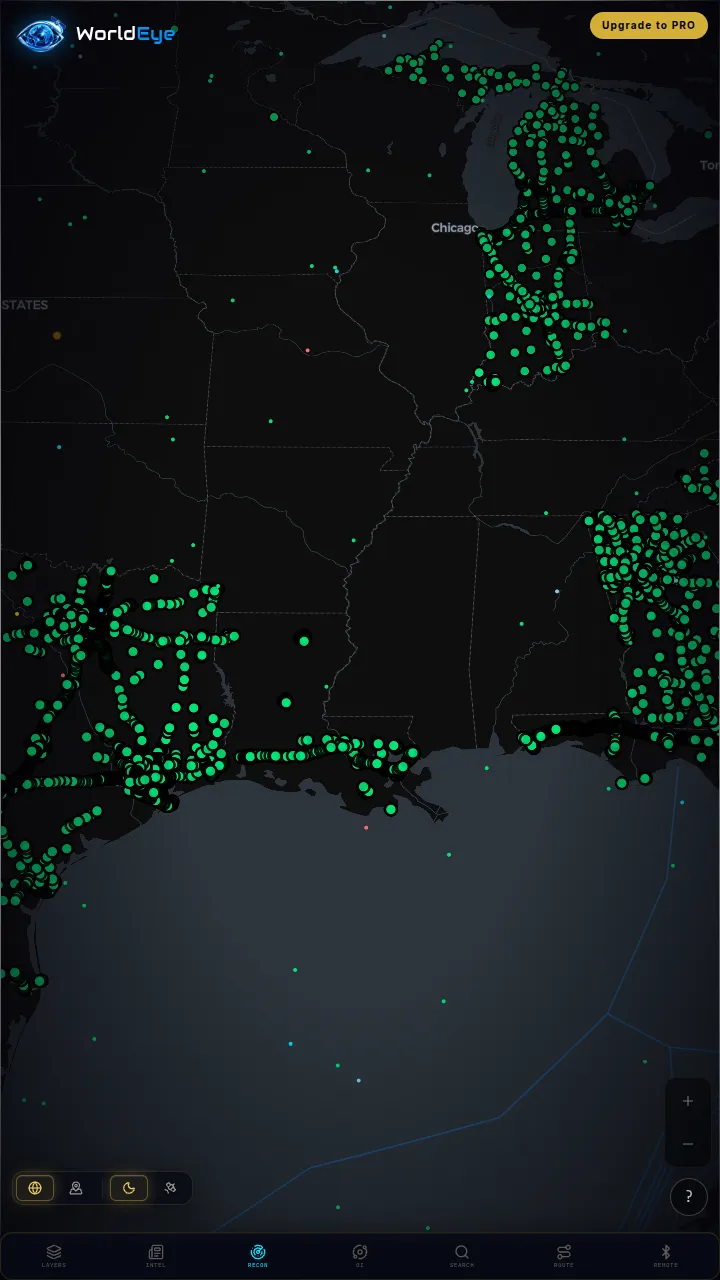
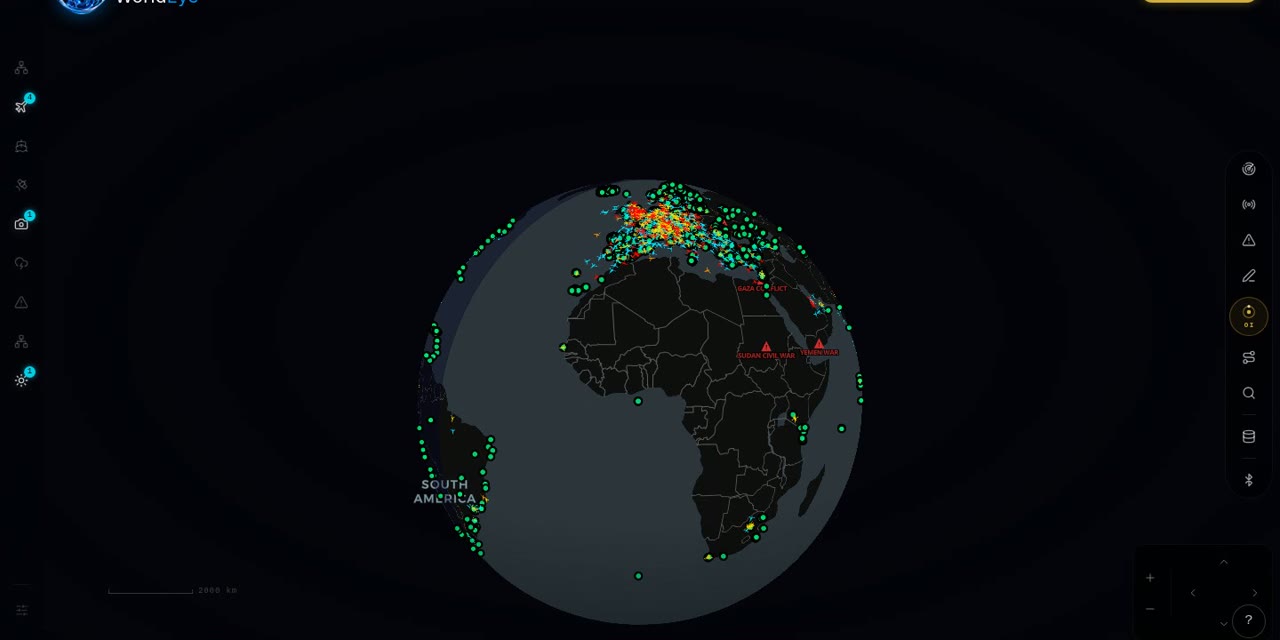
If what you actually want from either map is to see a place, not just read about it, WorldEye is the third shape: a hosted 3D globe that opens free in any browser with no signup — 74,229 public cameras across 105 countries, alongside live flights, ships, satellites, weather, earthquakes and wildfires in the same view. It does not fuse World Monitor's breadth of intel feeds or match LiveUAMap's analyst-verified newsroom and archive, and its Pro tier ($7.99/week, $13.99/month or $74.99/year) buys an OSINT toolkit and intel feeds rather than either of those.
Live on WorldEye right now
Real cameras from WorldEye's live catalogue — no account, no install. Tap any frame to open that exact camera on the globe.
Full WorldEye head-to-heads: WorldEye vs World Monitor · WorldEye vs LiveUAMap
World Monitor vs LiveUAMap: quick answers
Is World Monitor really free?
Yes. The hosted dashboard is free at $0 with no signup, and its homepage states every map layer except Resilience is included. Pro ($39.99/month) adds the AI analyst, personal digest, MCP connectors and widget builder; the source code is also free under AGPL-3.0 if you self-host.
Is LiveUAMap free?
Yes, with advertising. The free version no longer shows joint regions or historic data for previous years. An Ad-free account costs $9.54 per half-year and removes advertising only; PRO from $7/month adds satellite maps, custom regions, location search, history and data export.
Which has more data layers, World Monitor or LiveUAMap?
World Monitor, by its own dated homepage figures: 59 map layer types and 468 news and OSINT feeds as of 26 October 2026, spanning conflicts, aircraft, ships, fires, earthquakes and markets. Note its second domain publishes different counts (500+ feeds, 56 layers) — we use the dated worldmonitor.app figures. LiveUAMap's depth is regional and editorial instead: 30+ regions of fact-checked news.
Does either World Monitor or LiveUAMap have live cameras?
No. No webcam feature appears on World Monitor's official homepage or Pro page, and LiveUAMap documents no camera network. For live public cameras, WorldEye's directory lists 74,229 across 105 countries, free with no signup.
Who checks the facts on each map?
LiveUAMap describes a human process: AI web crawlers find stories, expert analysts fact-check them, and editors decide what is displayed. World Monitor instead correlates many attributed feeds and data sources (including ACLED and UCDP for conflicts) and adds AI-synthesised country briefs — breadth and attribution rather than an analyst desk.
Can I use either on my phone?
LiveUAMap has dedicated iOS and Android apps with notifications. World Monitor lists web access, native desktop apps for Windows, macOS and Linux, and an Android TV app; no native phone app is claimed on its official pages, though the web dashboard itself runs in a browser.
How we researched this comparison
Every row in the table above was checked against World Monitor’s and LiveUAMap’s official sites, documentation or published pricing — the sources are listed at the bottom of this page, and the comparison was last reviewed in October 2026. Where a capability couldn’t be confirmed from an official source, it is marked “Not verified” rather than guessed.
This page is published by WorldEye, so the head-to-head above is kept deliberately neutral: each product’s strengths are stated in its own terms, and WorldEye appears only in the labelled “another option” section. WorldEye’s own figures there are counted, not estimated — 74,229 public cameras in its live directory across 105 countries, and a free map (flights, satellites, ships, weather, earthquakes, wildfires, cameras and satellite imagery) with an optional Pro tier at $7.99/week, $13.99/month or $74.99/year.
Products change. If you spot a row that has gone stale, the sources below show exactly what each claim rests on.