SATELLITE IMAGERY HEAD-TO-HEAD
Sentinel Hub vs Zoom Earth (2026)
Sentinel Hub and Zoom Earth both show you the Earth from space, and that is almost where the resemblance ends. Sentinel Hub, run by Sinergise, a Planet Labs company, is a cloud platform for developers and researchers: seven APIs that search, process, analyse and download analysis-ready satellite data, metered in processing units, with the free EO Browser as its showcase viewer. Zoom Earth, by Neave Interactive, is a consumer weather map anyone can open for free: live satellite imagery updated every 10 minutes, rain radar, forecast maps and a hurricane tracker, on the web and in iOS and Android apps.
Sentinel Hub is the workshop — satellite data as a programmable, metered cloud service for people who build things with it. Zoom Earth is the window — the same planet as a free, live weather picture for people who want to watch it. One is priced in processing units with no public price list; the other is free with an optional app-store Pro tier.
Last reviewed: October 2026 · Sources listed at the bottom of this page
Quick facts
| Sentinel Hub | Zoom Earth | |
|---|---|---|
| Model | Cloud Earth-observation platform and APIs, with a free EO Browser showcase | Free interactive weather map and hurricane tracker |
| Maker | Sinergise Solutions d.o.o., a Planet Labs company | Neave Interactive Limited |
| Runs on | Web apps and APIs; no official native mobile app found | Web, iOS and Android apps |
| Free tier | EO Browser free showcase; 30-day free trial for API-level access | The full map free with no account required |
| Paid tier | Subscriptions metered in processing units — no public price published | Zoom Earth Pro — $1.99 and $11.99 price points on the US App Store listing; billing period not labelled |
| Data and APIs | Sentinel, Landsat, Planet and Maxar data through 7 APIs | GOES, Himawari and Meteosat imagery every 10 minutes; no public API |
Key differences at a glance
- Public API accessSentinel Hub: YesZoom Earth: NoSentinel Hub documents 7 APIs for search, processing, statistics and OGC services; no public Zoom Earth API was found, and its terms prohibit scraping and automated access
- Live weather satellite imagery every 10 minutesSentinel Hub: NoZoom Earth: YesZoom Earth updates geostationary imagery from GOES, Himawari and Meteosat every 10 minutes; Sentinel Hub is an archive and processing platform, not a 10-minute weather feed
- Rain radar and nowcastingSentinel Hub: NoZoom Earth: YesZoom Earth maps rain and snow from ground-based Doppler radar in real time with radar nowcasting; Sentinel Hub does not offer a rain radar product
- Hurricane and storm trackingSentinel Hub: NoZoom Earth: YesZoom Earth tracks hurricanes using NHC, JTWC, NRL and IBTrACS data; Sentinel Hub has no storm tracker
What is Sentinel Hub?
Sentinel Hub is a cloud-based service providing easy access to global archives of analysis-ready Earth observation data from the major providers. Its documentation lists seven APIs — Processing, Batch Processing, Bring Your Own COG, Catalog, Third Party Data Import, Statistical and OGC — covering the Sentinels (including Sentinel-1, Sentinel-2, Sentinel-3 and Sentinel-5P), Landsat, commercial Planet PlanetScope and Maxar collections, elevation models and more, plus bring-your-own-data collections and custom scripting. EO Browser is described in its documentation as a free web application that showcases the service — search, view, analyse and download data on the fly. An account is required for API use, and paid subscriptions are metered in processing units.
What is Zoom Earth?
Zoom Earth is, in its own terms, an interactive weather map of the world and a real-time hurricane tracker, provided by Neave Interactive Limited. Live satellite images from NOAA GOES, JMA Himawari and EUMETSAT Meteosat geostationary satellites are updated every 10 minutes, with HD images updated twice a day from NASA polar-orbiting satellites Aqua and Terra. Around that imagery it layers a rain radar with nowcasting, forecast maps from DWD ICON and NOAA GFS models (precipitation, wind, temperature, pressure and more), hurricane tracking using NHC, JTWC, NRL and IBTrACS data, and wildfire heat spots from NASA FIRMS. It runs on the web and as iOS and Android apps, and no account is required for basic use — an account is optional and carries a Pro subscription across devices.
Sentinel Hub vs Zoom Earth: feature comparison
Verified against official sources. “Not verified” means we couldn’t confirm it — not that it doesn’t exist.
FEATURE TALLY — FROM THE TABLE BELOW
Sentinel Hub
5 yes · 1 partial · 7 no · 1 not verified
Zoom Earth
8 yes · 0 partial · 6 no
A count of the rows in the verified table beneath — not a quality rating. The rows themselves, and what each product does best, matter more than the totals.
| Feature | Sentinel Hub | Zoom Earth |
|---|---|---|
| Satellite imagerySentinel Hub processes multi-mission archive and current imagery (Sentinels, Landsat, Planet, Maxar); Zoom Earth shows near real-time weather satellite imagery | Yes | Yes |
| Public API accessSentinel Hub documents 7 APIs for search, processing, statistics and OGC services; no public Zoom Earth API was found, and its terms prohibit scraping and automated access | Yes | No |
| Live weather satellite imagery every 10 minutesZoom Earth updates geostationary imagery from GOES, Himawari and Meteosat every 10 minutes; Sentinel Hub is an archive and processing platform, not a 10-minute weather feed | No | Yes |
| Rain radar and nowcastingZoom Earth maps rain and snow from ground-based Doppler radar in real time with radar nowcasting; Sentinel Hub does not offer a rain radar product | No | Yes |
| Hurricane and storm trackingZoom Earth tracks hurricanes using NHC, JTWC, NRL and IBTrACS data; Sentinel Hub has no storm tracker | No | Yes |
| Weather forecast mapsZoom Earth publishes forecast maps for precipitation, wind, gusts, temperature, humidity and pressure from ICON and GFS models; Sentinel Hub is not a forecast-map product | No | Yes |
| Analysis-ready data, custom scripting and statisticsSentinel Hub offers custom scripts (evalscripts), multi-temporal processing and a Statistical API over areas and time; Zoom Earth is a viewer with no equivalent processing pipeline | Yes | No |
| Commercial satellite collectionsSentinel Hub lists Planet PlanetScope and SkySat Archive and Maxar WorldView/GeoEye among its collections; Zoom Earth uses public weather satellites | Yes | No |
| Free to open with no accountEO Browser is presented as a free showcase app, but Sentinel Hub API use requires an account; Zoom Earth needs no account for basic use and an account is explicitly optional | Partial | Yes |
| Developer and GIS integrationSentinel Hub integrates via its APIs, a Python package and OGC services for tools such as QGIS and ArcGIS; Zoom Earth offers measure tools on the map but no developer integration was found | Yes | No |
| Native iOS and Android appsNo official native Sentinel Hub mobile app was found on the pages checked; Zoom Earth publishes iOS and Android apps as well as the website | No | Yes |
| Wildfire heat spotsZoom Earth shows active fires and heat spots updated daily with NASA FIRMS data; a dedicated wildfire overlay was not confirmed as a Sentinel Hub product feature on the pages checked | Not verified | Yes |
| Live public camerasNeither product is a live camera network — both show the Earth from satellites, not from ground cameras | No | No |
| Live flights and shipsNeither tracks aircraft or vessels; both are satellite-imagery products | No | No |
Pricing: Sentinel Hub vs Zoom Earth
Sentinel Hub pricing
No public price is published for Sentinel Hub. Its pricing page redirects to Planet pricing with contact-sales options and no Sentinel Hub plan prices listed, so no euro or dollar figure can be confirmed from official public pages. What is published is the structure: paid subscriptions metered in processing units (PU), with the official FAQ giving allowances of 30,000 PU per month for Exploration (which does not support commercial use), up to 70,000 PU per month for Basic, and 400,000 PU per month for Enterprise S, plus a top-up package of 50,000 PU. A 30-day free trial gives API-level access, and EO Browser is a free showcase application.
Zoom Earth pricing
Zoom Earth is free on the web and its apps are listed at 0 USD on the App Store and Google Play, with an optional auto-renewable Zoom Earth Pro subscription for more features. The official US App Store listing shows two Zoom Earth Pro price points — $1.99 and $11.99 — under in-app purchases, but the listing checked does not label which billing period each price corresponds to, so the period for either price is unverified. No free trial for Pro was stated on the official pages checked, and no separate pricing page was found on zoom.earth itself — pricing is surfaced through the app stores.
Sentinel Hub: pros and cons
- Seven documented APIs for search, processing, statistics and download
- Deep catalogue: Sentinels, Landsat, Planet, Maxar, DEMs and more
- Custom scripting, multi-temporal processing and bring-your-own-data
- Free EO Browser showcase and a 30-day API-level free trial
- GIS-ready through OGC services and a Python package
- No public prices — subscriptions are sold by processing units via Planet
- Account required for API use
- No official native iOS or Android app found
- No live weather radar, forecast maps or hurricane tracker
- Built for developers and researchers, not casual viewing
Zoom Earth: pros and cons
- Completely free to open — no account required for basic use
- Satellite imagery updated every 10 minutes from geostationary satellites
- Rain radar with nowcasting and dedicated hurricane tracking
- Forecast maps from ICON and GFS models, plus NASA FIRMS fire spots
- Web, iOS and Android apps from the same provider
- No public API — terms prohibit scraping and automated access
- No analysis-ready archives, custom processing or statistics
- No live cameras, flights or ships — weather only
- Pro billing periods are not labelled on the App Store listing checked
- No developer or GIS integration
The verdict
Choose Sentinel Hub if…
Choose Sentinel Hub if you are building with satellite data — an application, a research pipeline, a GIS workflow — and need analysis-ready imagery, custom processing and statistics through an API, metered in processing units after a 30-day free trial.
Choose Zoom Earth if…
Choose Zoom Earth if you want to watch the weather itself — a developing hurricane, a rain front, smoke from a fire — in near real time, for free, with nothing to set up and no account needed.
Is Sentinel Hub better than Zoom Earth?
They solve different problems. Sentinel Hub is a developer platform: analysis-ready satellite data from Sentinel, Landsat, Planet and Maxar, processed in the cloud through seven APIs and paid for in processing units, with no public price list and a 30-day free trial. Zoom Earth is a consumer weather map: free, no account needed, with satellite imagery every 10 minutes, rain radar and hurricane tracking on web and mobile apps, and no API at all. If you want to *build with* satellite data, use Sentinel Hub; if you want to *watch the weather* from space, open Zoom Earth.
ANOTHER OPTION
Where WorldEye fits
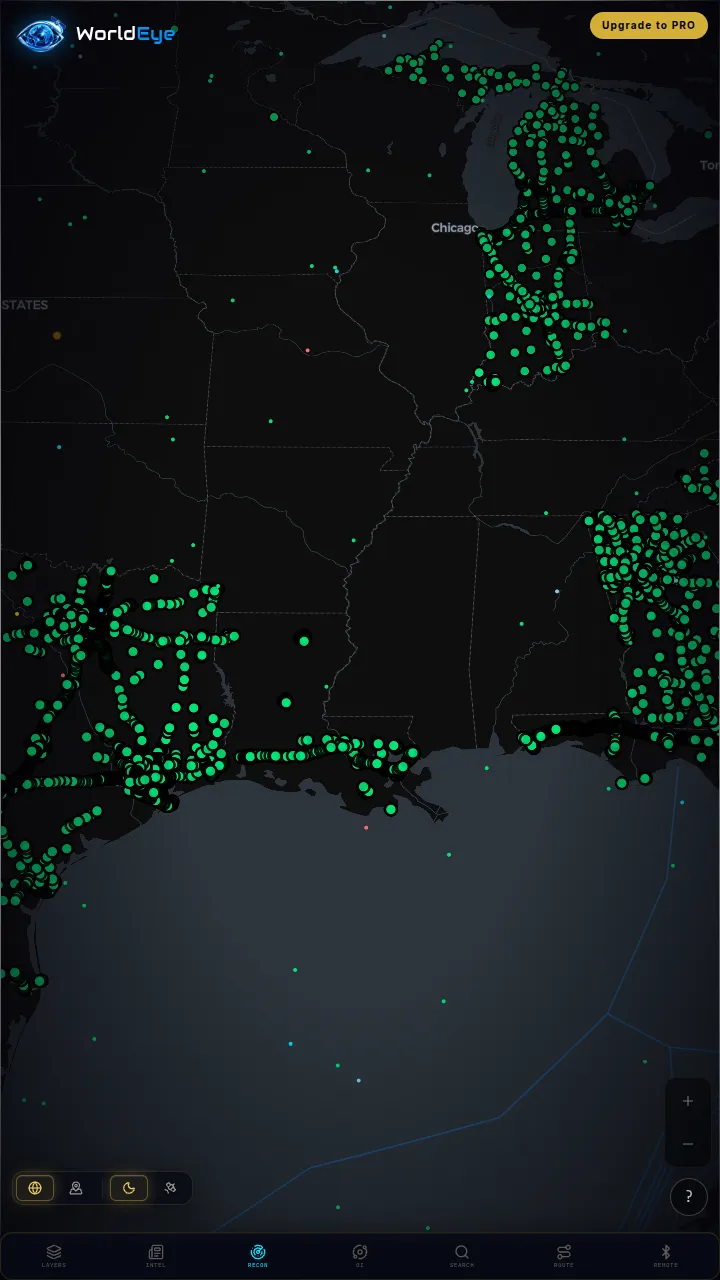
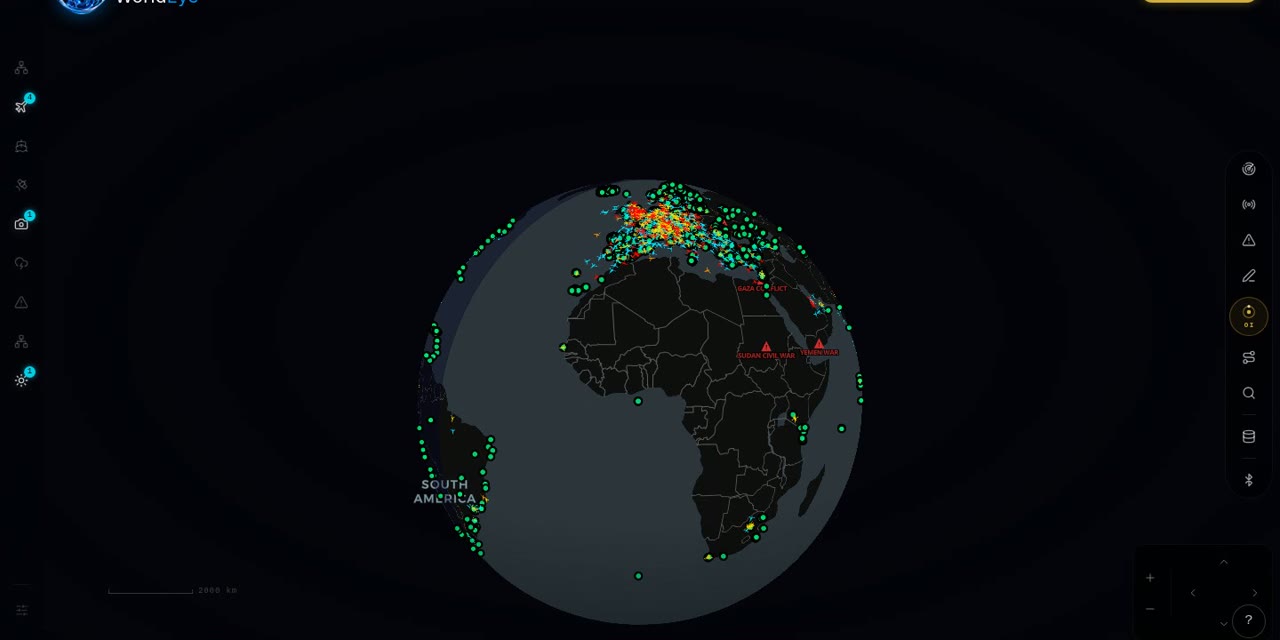
Neither of these helps you look at a place on the ground, and that is the gap WorldEye fills: a hosted 3D globe that opens free in any browser with no signup — 74,229 public cameras across 105 countries, alongside live flights, ships, satellites, weather, earthquakes and wildfires in the same view. WorldEye is not a processing platform like Sentinel Hub — it offers no Earth-observation API pipeline or processing units — and it is not a dedicated storm tool like Zoom Earth, whose radar and hurricane depth it does not match. Its Pro tier is $7.99/week, $13.99/month or $74.99/year for viewers who want more of the globe, not a data pipeline.
Live on WorldEye right now
Real cameras from WorldEye's live catalogue — no account, no install. Tap any frame to open that exact camera on the globe.
Full WorldEye head-to-heads: WorldEye vs Sentinel Hub · WorldEye vs Zoom Earth
Sentinel Hub vs Zoom Earth: quick answers
Is Sentinel Hub the same kind of product as Zoom Earth?
No. Sentinel Hub is a cloud Earth-observation platform for developers and researchers — APIs that search, process and analyse satellite data, metered in processing units. Zoom Earth is a free consumer weather map with live satellite imagery, radar and storm tracking. They share satellite pictures and little else.
Is Sentinel Hub free?
Partly. EO Browser, its showcase viewer, is described as a free web application, and there is a 30-day free trial with API-level access. API use beyond that is a paid subscription metered in processing units — Exploration at 30,000 PU per month, Basic up to 70,000 PU and Enterprise S at 400,000 PU in the official FAQ's examples. No public price is published; its pricing page redirects to Planet with contact-sales options.
How much does Zoom Earth Pro cost?
The app itself is free. The official US App Store listing shows two Zoom Earth Pro in-app purchase price points, $1.99 and $11.99, described as auto-renewable subscriptions. The listing checked does not label which billing period each price corresponds to, so the period for either price is unverified — check the price shown in the app before subscribing.
Which has an API, Sentinel Hub or Zoom Earth?
Only Sentinel Hub. Its documentation lists seven APIs — Processing, Batch Processing, Bring Your Own COG, Catalog, Third Party Data Import, Statistical and OGC. No public Zoom Earth API was found on its official pages, and its terms prohibit accessing the service by automated means such as scraping or bulk downloading.
Which is better for tracking hurricanes and weather?
Zoom Earth, by design. It updates geostationary satellite imagery every 10 minutes, adds rain radar with nowcasting and forecast maps from ICON and GFS models, and tracks hurricanes with NHC, JTWC, NRL and IBTrACS data. Sentinel Hub can supply satellite data for analysis, but it has no weather maps, radar or storm tracker as a product.
Which is better for building an app or analysing imagery?
Sentinel Hub. It is built for programmatic access: analysis-ready Sentinel, Landsat, Planet and Maxar collections, custom scripts, multi-temporal processing, a Statistical API and OGC services for GIS tools. Zoom Earth is a viewer — a very good one — with no developer integration.
How we researched this comparison
Every row in the table above was checked against Sentinel Hub’s and Zoom Earth’s official sites, documentation or published pricing — the sources are listed at the bottom of this page, and the comparison was last reviewed in October 2026. Where a capability couldn’t be confirmed from an official source, it is marked “Not verified” rather than guessed.
This page is published by WorldEye, so the head-to-head above is kept deliberately neutral: each product’s strengths are stated in its own terms, and WorldEye appears only in the labelled “another option” section. WorldEye’s own figures there are counted, not estimated — 74,229 public cameras in its live directory across 105 countries, and a free map (flights, satellites, ships, weather, earthquakes, wildfires, cameras and satellite imagery) with an optional Pro tier at $7.99/week, $13.99/month or $74.99/year.
Products change. If you spot a row that has gone stale, the sources below show exactly what each claim rests on.
Sources
- Sentinel Hub — official site
- Sentinel Hub — official FAQ
- Sentinel Hub — official data collections
- Sentinel Hub — documentation, Beginners Guide
- Sentinel Hub — EO Browser
- Zoom Earth — official site
- Zoom Earth — official terms of service
- Zoom Earth — official App Store listing
- Zoom Earth — official Google Play listing