SATELLITE IMAGERY HEAD-TO-HEAD
Zoom Earth vs NASA Worldview (2026)
Zoom Earth and NASA Worldview both show you the planet from space, live and free — and they are built for very different readers. Zoom Earth, by Neave Interactive, is the consumer live-weather satellite: imagery every 10 minutes, rain radar with nowcasting, forecast layers and a hurricane tracker, in an app anyone can read in seconds. NASA Worldview is NASA's science instrument: more than 1,000 near-real-time satellite layers, an archive reaching back nearly 30 years in places, event tracking, time-lapse tools and downloadable data — powerful, and unmistakably a research tool. One is for checking the storm today; the other is for studying the Earth system.
Zoom Earth is the daily driver: live weather satellite for everyone, at a glance. NASA Worldview is the laboratory: the deepest free window onto the Earth system ever published. For watching today's storm, open Zoom Earth; for understanding the planet, open Worldview.
Last reviewed: October 2026 · Sources listed at the bottom of this page
Quick facts
| Zoom Earth | NASA Worldview | |
|---|---|---|
| Model | Interactive weather map and hurricane tracker — free with optional Pro | Satellite-imagery browser for science — completely free public service |
| Maker | Neave Interactive Limited | NASA (EOSDIS) |
| Runs on | Web plus iOS and Android apps | Web browser — desktop and mobile, flat map with polar projections |
| Free tier | Full basic use free, no account required | Everything free, no signup required |
| Paid tier | Zoom Earth Pro — $1.99 and $11.99 on the US App Store listing; billing period for each price unverified | None — no paid plans |
| Imagery refresh | Geostationary satellite every 10 minutes; HD NASA passes twice a day | Most layers within ~3 hours of observation; geostationary in 10-minute increments |
Key differences at a glance
- Weather forecast maps (models)Zoom Earth: YesNASA Worldview: NoZoom Earth layers ICON and GFS forecast maps for rain, wind, temperature and pressure; Worldview is not a weather-forecast product — its layers are observations and science products
- Rain radar with nowcastingZoom Earth: YesNASA Worldview: NoZoom Earth's radar shows rain and snow from ground-based Doppler radar in real time with nowcasting; Worldview has precipitation imagery layers, not a radar nowcast
- Hurricane and cyclone trackingZoom Earth: YesNASA Worldview: PartialZoom Earth is a dedicated real-time hurricane tracker using NHC, JTWC, NRL and IBTrACS data; Worldview pins and tracks cyclones as natural events, without a dedicated storm tracker
- 1,000+ science data layersZoom Earth: NoNASA Worldview: YesWorldview offers over 1,000 full-resolution layers — air quality, sea ice, vegetation and more; Zoom Earth is a focused weather layer set
What is Zoom Earth?
Zoom Earth, by Neave Interactive Limited, is an interactive weather map of the world and a real-time hurricane tracker, free on the web, iOS and Android. It shows near real-time satellite imagery — live images from NOAA GOES, JMA Himawari and EUMETSAT Meteosat geostationary satellites updated every 10 minutes, plus HD images updated twice a day from NASA polar-orbiting satellites Aqua and Terra — alongside rain radar with nowcasting, forecast maps from DWD ICON and NOAA GFS, hurricane tracking using NHC, JTWC, NRL and IBTrACS data, and an active fires overlay updated daily with data from NASA FIRMS. No account is required for basic use.
What is NASA Worldview?
NASA Worldview is NASA EOSDIS's free, open-source browser for near-real-time satellite imagery: more than 1,000 global, full-resolution layers — fires, storms, air quality, sea ice, vegetation and more — most updated within about three hours of observation, some spanning nearly 30 years, with geostationary imagery in 10-minute increments. It adds event pins for cyclones, wildfires and eruptions, time-lapse animation building, layer comparison (swipe and opacity) and downloadable underlying data via NASA's GIBS services. It is a flat map with polar projections, not a 3D globe, and it is not a weather-forecast product. No signup; it runs in the browser.
Zoom Earth vs NASA Worldview: feature comparison
Verified against official sources. “Not verified” means we couldn’t confirm it — not that it doesn’t exist.
FEATURE TALLY — FROM THE TABLE BELOW
Zoom Earth
7 yes · 1 partial · 4 no · 2 not verified
NASA Worldview
9 yes · 1 partial · 4 no
A count of the rows in the verified table beneath — not a quality rating. The rows themselves, and what each product does best, matter more than the totals.
| Feature | Zoom Earth | NASA Worldview |
|---|---|---|
| Near-real-time satellite imageryZoom Earth: geostationary imagery from GOES, Himawari and Meteosat every 10 minutes. Worldview: 1,000+ layers, most updated within about 3 hours of observation, with geostationary imagery in 10-minute increments | Yes | Yes |
| Weather forecast maps (models)Zoom Earth layers ICON and GFS forecast maps for rain, wind, temperature and pressure; Worldview is not a weather-forecast product — its layers are observations and science products | Yes | No |
| Rain radar with nowcastingZoom Earth's radar shows rain and snow from ground-based Doppler radar in real time with nowcasting; Worldview has precipitation imagery layers, not a radar nowcast | Yes | No |
| Hurricane and cyclone trackingZoom Earth is a dedicated real-time hurricane tracker using NHC, JTWC, NRL and IBTrACS data; Worldview pins and tracks cyclones as natural events, without a dedicated storm tracker | Yes | Partial |
| Wildfire and heat-spot trackingZoom Earth shows active fires and heat spots updated daily from NASA FIRMS, with GeoColor imagery for smoke; Worldview pins wildfire events and carries fire layers among its 1,000+ layers | Yes | Yes |
| 1,000+ science data layersWorldview offers over 1,000 full-resolution layers — air quality, sea ice, vegetation and more; Zoom Earth is a focused weather layer set | No | Yes |
| Long historical archiveSome Worldview layers span nearly 30 years; a comparable long-term archive was not verified for Zoom Earth, which is built around current conditions | Not verified | Yes |
| Downloadable underlying dataWorldview's data is downloadable via NASA's GIBS services; Zoom Earth's terms prohibit bulk downloading and automated access | No | Yes |
| Time-lapse animationsWorldview builds custom time-lapse animations; Zoom Earth animates its live imagery and offers animation styles, but a custom time-lapse builder was not verified | Partial | Yes |
| Layer comparison and transparency toolsWorldview offers swipe and opacity comparison across layers; equivalent comparison tools were not verified for Zoom Earth | Not verified | Yes |
| Free access without an accountZoom Earth needs no account for basic use; Worldview is completely free with no signup to browse | Yes | Yes |
| Native mobile appsZoom Earth offers iOS and Android apps plus the web; Worldview is browser-based and works on desktop and mobile devices, with no native app verified | Yes | No |
| API and reusable data servicesWorldview's imagery is reusable via NASA GIBS services and its code is open source; no public Zoom Earth API was found and its terms prohibit scraping | No | Yes |
| Interactive 3D globeNeither offers one: Zoom Earth is a flat weather map; Worldview is a flat map with geographic and polar projections | No | No |
Pricing: Zoom Earth vs NASA Worldview
Zoom Earth pricing
Free on the web, iOS and Android, with no account required for basic use. Zoom Earth Pro is listed under In-App Purchases on the official US App Store listing at $1.99 and $11.99 — that listing does not label which billing period each price corresponds to, so the period for each price is unverified. Its terms say subscriptions are billed on a periodic basis (e.g. monthly or annually), as specified at the time of purchase. No free trial for Pro was stated on the official pages checked.
NASA Worldview pricing
Completely free — NASA provides Worldview as a public service through EOSDIS. No paid plans, and no signup is required to browse.
Zoom Earth: pros and cons
- Satellite imagery updated every 10 minutes, in a map anyone can read
- Rain radar with nowcasting and ICON/GFS forecast layers
- Dedicated hurricane tracker using NHC, JTWC, NRL and IBTrACS data
- Wildfire heat spots from NASA FIRMS
- Free on web, iOS and Android with no account required for basic use
- Only a handful of weather layers beside Worldview's 1,000+ science layers
- No downloadable science data — its terms prohibit bulk downloading
- Pro prices ($1.99 / $11.99) are listed without labelled billing periods
- No public API — its terms prohibit scraping and automated access
NASA Worldview: pros and cons
- 1,000+ full-resolution science layers, most within ~3 hours of observation
- Nearly 30 years of history in some layers, with time-lapse building
- Event pins for cyclones, wildfires and volcanic eruptions
- Underlying data downloadable via NASA GIBS; code is open source
- Completely free from NASA — no paid tier, no signup
- Flat map with polar projections — no 3D globe at all
- Not a weather-forecast product: no forecast models or radar nowcasting
- A research interface that takes time to learn
- Imagery is near-real-time (most layers within ~3 hours), not a live weather feed
The verdict
Choose Zoom Earth if…
Choose Zoom Earth if you want the live weather picture — a storm, a rain band or a fire, on a simple map or in the app, refreshed every 10 minutes — without learning a research tool.
Choose NASA Worldview if…
Choose NASA Worldview if you want the evidence — 1,000+ science layers, days-to-decades of history, time-lapse and comparison tools and downloadable NASA data for fires, storms, ice and air quality.
Is Zoom Earth better than NASA Worldview?
They answer different questions. Zoom Earth is better for live weather: what is this storm, rain band or fire doing right now, in a map anyone can read, on web or mobile? NASA Worldview is better for processes and evidence: what is happening across the planet's systems — fires, ice, air quality, vegetation — across 1,000+ science layers, with history and downloadable data. Both are free and need no account; keep Zoom Earth for the daily weather check and Worldview for the deep look.
ANOTHER OPTION
Where WorldEye fits
Zoom Earth and NASA Worldview both stop at the view from space — neither shows you the ground, and neither offers a 3D globe. WorldEye takes the third position: a free 3D globe with 74,229 public cameras across 105 countries alongside live flights, ships, satellites, weather, earthquakes and wildfires, so satellite context and ground-level reality sit in the same view, with a free tier and no signup. Its imagery is neither Zoom Earth's live weather feed nor NASA's science library, and it does not claim to be. Its optional Pro tier is $7.99/week · $13.99/month · $74.99/year.
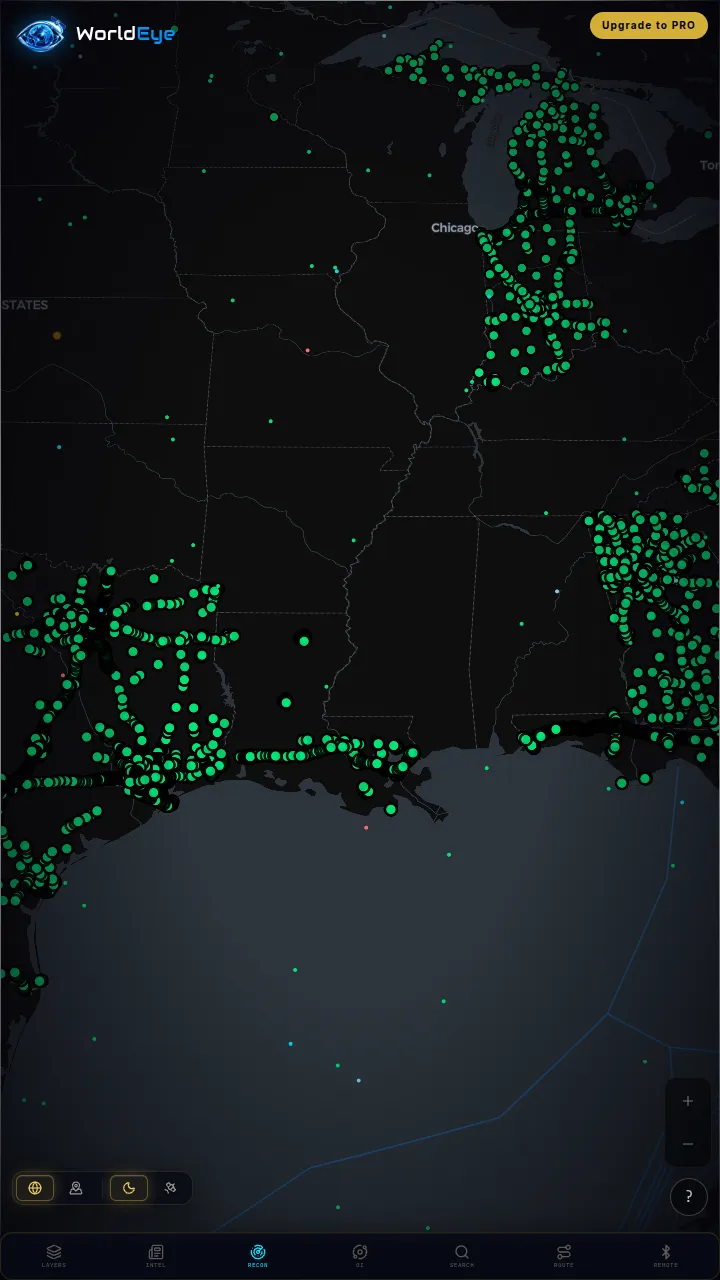
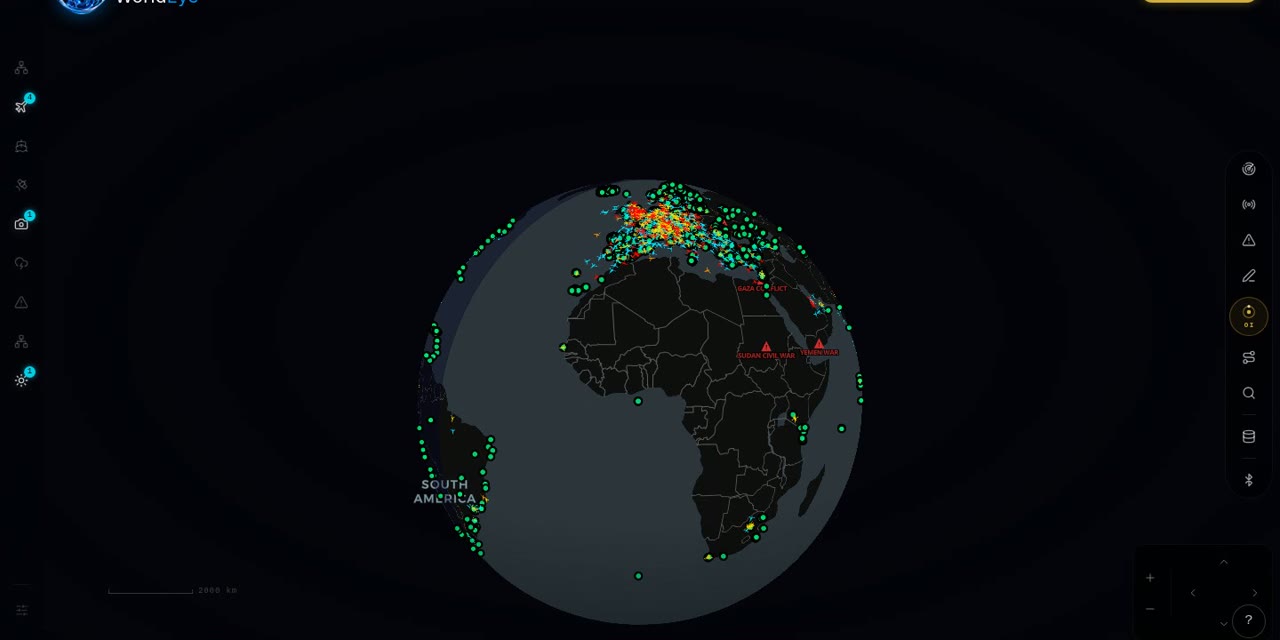
Live on WorldEye right now
Real cameras from WorldEye's live catalogue — no account, no install. Tap any frame to open that exact camera on the globe.
Full WorldEye head-to-heads: WorldEye vs Zoom Earth · WorldEye vs NASA Worldview
Zoom Earth vs NASA Worldview: quick answers
Is NASA Worldview a weather forecast app like Zoom Earth?
No. NASA Worldview is not a weather-forecast product — it shows near-real-time satellite imagery and environmental science layers (most updated within about three hours of observation). Zoom Earth is the forecast one here: it layers ICON and GFS forecast maps and rain radar with nowcasting over its live satellite imagery.
How many layers does NASA Worldview have?
More than 1,000 global, full-resolution layers — satellite imagery and science products covering fires, storms, air quality, temperature, sea ice, vegetation and hundreds of other variables, many updated near-real-time and some spanning nearly 30 years.
Is Zoom Earth free?
Yes — Zoom Earth is completely free for basic use on the web, iOS and Android, with no account required. Extra features sit behind Zoom Earth Pro, listed on the official US App Store listing at $1.99 and $11.99, though that listing does not label which billing period each price corresponds to.
Is NASA Worldview really free?
Yes, completely. NASA provides Worldview as a public service through EOSDIS — no paid plans, no subscriptions, and no signup required to browse. Its code is open source and the underlying imagery data is downloadable via NASA's GIBS services.
Which has a 3D globe, Zoom Earth or NASA Worldview?
Neither. Zoom Earth is a flat interactive weather map, and NASA Worldview is a flat map with geographic and polar projections. For a 3D globe that combines a satellite view with live flights, ships, cameras and weather, that is WorldEye's position — see below.
Which is better for tracking a hurricane?
Zoom Earth, for watching a storm live: satellite imagery every 10 minutes, radar nowcasting and a dedicated hurricane tracker fed by NHC, JTWC, NRL and IBTrACS. Worldview is the better second look — it pins and tracks cyclones as natural events and lets you build time-lapse animations and compare layers over days.
How we researched this comparison
Every row in the table above was checked against Zoom Earth’s and NASA Worldview’s official sites, documentation or published pricing — the sources are listed at the bottom of this page, and the comparison was last reviewed in October 2026. Where a capability couldn’t be confirmed from an official source, it is marked “Not verified” rather than guessed.
This page is published by WorldEye, so the head-to-head above is kept deliberately neutral: each product’s strengths are stated in its own terms, and WorldEye appears only in the labelled “another option” section. WorldEye’s own figures there are counted, not estimated — 74,229 public cameras in its live directory across 105 countries, and a free map (flights, satellites, ships, weather, earthquakes, wildfires, cameras and satellite imagery) with an optional Pro tier at $7.99/week, $13.99/month or $74.99/year.
Products change. If you spot a row that has gone stale, the sources below show exactly what each claim rests on.